Our View, Constructive but Hedging the Risks: We remain constructive on the broad market, with the S&P 500 logging its ninth straight weekly advance, but we are aware of building downside risks in mega-cap growth, which is why we are adding an active protective position in NVDA alongside our bullish breakout ideas.
Bifurcation and rotation: The Dow tagged a fresh all-time closing high Thursday near 52,900 while the Nasdaq Composite dropped 2.2%, its worst session since April and the widest Dow/Nasdaq gap in over eighteen months. Money is rotating out of concentrated AI winners into financials, industrials, and defensives (UnitedHealth, Caterpillar, Home Depot led the Dow), though small caps lagged as the Russell 2000 gave back 1.26% and failed to hold 3,000.
June jobs, the pivot: Payrolls printed +57K versus +115K consensus with May revised down to +129K. Unemployment ticked to 4.2%, but mechanically, as participation fell to 61.5%, the lowest since March 2021. The 10-year yield fell ~7 bps to 4.485%, yet rate-cut odds barely moved, with CME FedWatch showing an 81.2% probability of a July 29 hold.
AI reset and cross-asset: Tesla fell 7.5% despite beating Q2 delivery estimates, with Micron -7.0%, Applied Materials -7.4%, AMD -4.3%, and Nvidia -1.4% as investors questioned AI capex durability, the fifth or sixth AI valuation reset in twelve months. Gold rallied above $4,100/oz on the jobs miss while oil stayed quiet (WTI $68.11) and Bitcoin held near 21-month lows around $61,500.
OptionsPlay Trade Ideas: The Daily Brief
💰 The Income Generators (High Probability, Cash Flow)
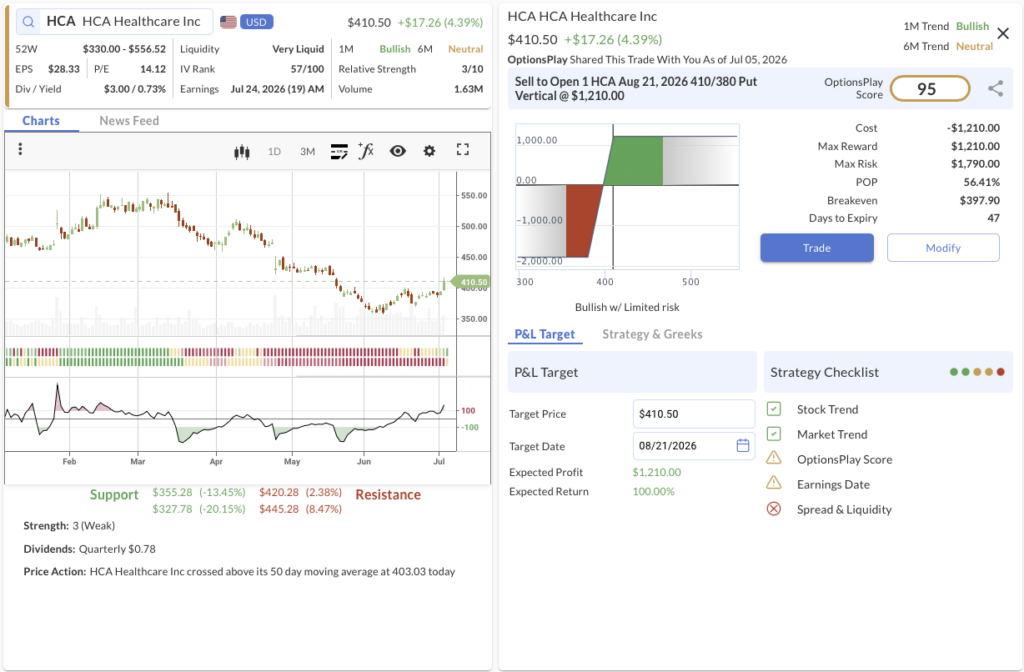
HCA: Selling a put spread into HCA’s high-volume breakout above $400, collecting income while the healthcare rotation runs.
🚀 The Growth Seekers (Higher Risk, Max Reward)
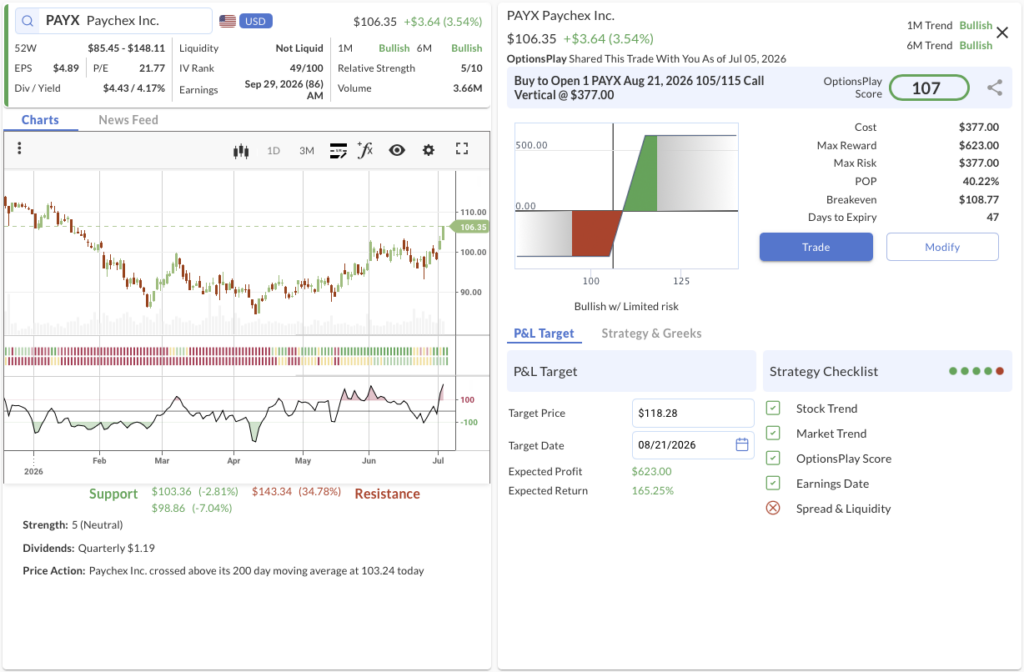
PAYX: Pressing a winning position with a call spread as PAYX breaks out above $102.50 and targets $115.
🛡️ The Portfolio Protectors (Hedges & Bearish Bets)
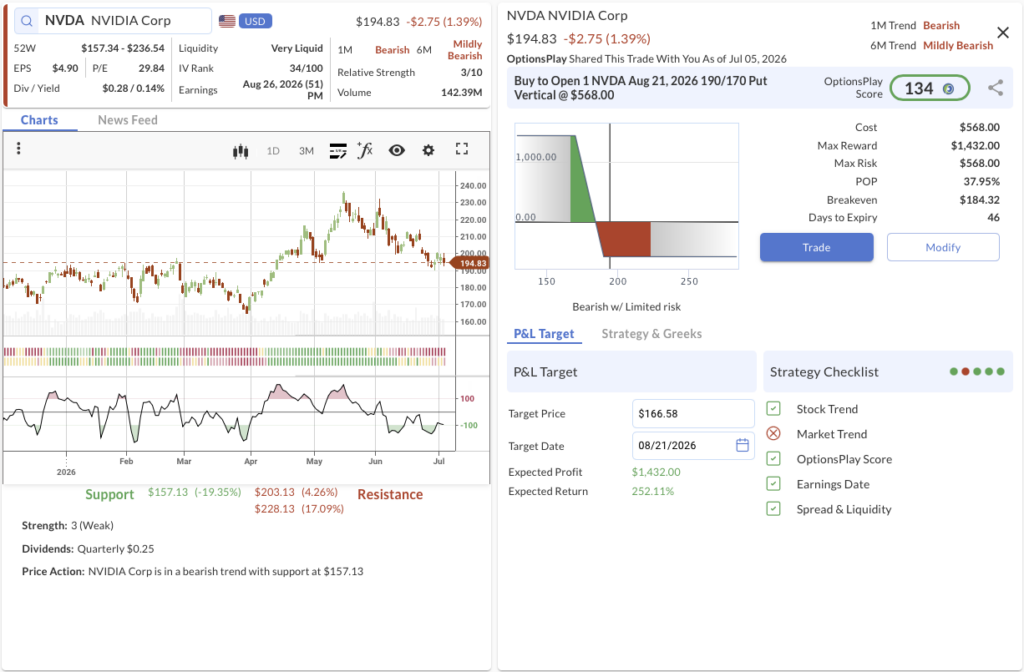
NVDA: Buying a cheap out-of-the-money put spread to hedge mega-cap growth weakness as NVDA breaks below $200 toward $170.
1. HCA ($410.50): Collecting Income on the $400 Breakout
We’re betting on: HCA affirmed its 2026 EPS guidance of $29.10–$31.50 and carries a Buy analyst consensus, and for HCA to stay above $410 by expiration to capture the full credit.
The Trade: Sell to Open the HCA Aug 21, 2026 410/380 Put Vertical @ $12.10 Credit.
🔴 SELL TO OPEN Aug 21, 2026 410 Put @ $21.50
🟢 BUY TO OPEN Aug 21, 2026 380 Put @ $9.40
Trade Metrics: POP: 56.42% | Collect $1,210 per contract vs. a Max Risk of $1,790 (1.48:1).
The Setup: HCA broke out above the $400 level on strong volume and reclaimed its 50-day moving average at $403.03, with the stock now at $410.50 and a 1-month bullish trend targeting $440 to the upside. The rotation into defensives and healthcare described in this week’s tape gives the move a clean macro tailwind as money leaves concentrated AI names. Analysts hold a Buy consensus (14 of 25 rate it Strong Buy) with an affirmed 2026 EPS outlook of $29.10–$31.50 on $76.5B–$80B of revenue, though targets have drifted lower after Q1. The defined-risk short put vertical collects $1,210 against $1,790 of risk with a 56.42% probability of profit and a breakeven of $397.90, comfortably below the breakout level.
Management:
⚠️ Warning: Earnings are scheduled for July 24, 2026, potentially requiring active monitoring around the event.
Stop Loss: Buy back the spread at $24.20 (100% loss of credit received).
Take Profit: Buy back the spread at $6.05 (50% of max gain).
2. PAYX ($106.35): Pressing the Winner Toward $115
We’re betting on: Paychex’s Q4 revenue accelerated 12% with the Paycor integration already clearing its synergy target, and for PAYX to close above $115 by expiration to capture the full spread.
The Trade: Buy to Open the PAYX Aug 21, 2026 105/115 Call Vertical @ $3.77 Debit.
🟢 BUY TO OPEN Aug 21, 2026 105 Call @ $5.30
🔴 SELL TO OPEN Aug 21, 2026 115 Call @ $1.53
Trade Metrics: POP: 40.24% | Pay $377 per contract vs. a Max Reward of $623 (1.65:1).
The Setup: PAYX broke out above its $102.50 resistance and crossed back above its 200-day moving average at $103.24, generating a fresh early-breakout signal with the stock at $106.35 and a target of $115. This presses a winner we already own: our short Jul 17 100/95 put vertical from June 11 is marked up about 54% (+$615), and the breakout gives us a second, defined-risk way to add upside exposure. Fundamentally, Paychex just posted 12% Q4 revenue growth and 17% full-year growth as the Paycor deal exceeded its $100M synergy target and lifted organic growth to a 5–6% exit rate. The 105/115 debit call vertical pays $377 to open against $623 of max reward, a 1.65:1 payout, and needs PAYX to hold its breakout and push toward $115 into August expiration.
Management:
Stop Loss: Sell the spread at $1.89 (50% loss on premium).
Take Profit: Sell the spread at $6.60 (75% gain on premium).
3. NVDA ($194.83): Cheap Protection as AI Cools
We’re betting on: Mega-cap growth is showing signs of distribution while NVDA faces rising AI-capex and pricing pressure, and for NVDA to fall to $170 by expiration to capture the full spread.
The Trade: Buy to Open the NVDA Aug 21, 2026 190/170 Put Vertical @ $5.68 Debit.
🟢 BUY TO OPEN Aug 21, 2026 190 Put @ $8.73
🔴 SELL TO OPEN Aug 21, 2026 170 Put @ $3.05
Trade Metrics: POP: 37.94% | Pay $568 per contract vs. a Max Reward of $1,432 (2.52:1).
The Setup: NVDA broke below the $200 level and now sits at $194.83 in a bearish 1-month trend with relative strength at just 3/10, showing signs of distribution as this week’s rotation pulled money out of concentrated AI-infrastructure winners. We remain constructive on semiconductors for the long term but are buying cheap, out-of-the-money protection while the tape stays vulnerable: analysts are flagging softer pricing power, rising competition from cheaper models, and hyperscaler capex anxiety as near-term risks. The 190/170 put vertical costs $568 and pays up to $1,432 if NVDA works toward $170, a 2.52:1 payout on strictly defined risk that hedges our broader constructive book. The position turns profitable below the $184.32 breakeven, and reaches maximum value at or below the $170 short strike by August expiration.
Management:
Stop Loss: Sell the spread at $2.84 (50% loss on premium).
Take Profit: Sell the spread at $9.94 (75% gain on premium).







Share this on