

HOOD, UNP

OptionsPlay DailyPlay Ideas Menu – July 2nd, 2026

What’s Driving The Market
- Rotation, Not Retreat: Q3 opened with the S&P 500 and Nasdaq digesting their best half in years as profit-taking hit the crowded AI and semiconductor trade (Micron down more than 10% despite still being up over 260% year to date, alongside Nebius, CoreWeave, and ChronoScale), while breadth stayed constructive: Communication Services, Financials, and Industrials all led, the Russell 2000 finished green, and NYSE advancers ran near 66%.
- Dovish Data Mix: ADP printed a soft +98K against a +110K consensus with hiring caution concentrated in leisure and hospitality, while ISM Manufacturing slipped to 53.3 but the Prices Paid subindex dropped sharply to 73.0 from 82.1, a welcome disinflation signal even as the composite marked its 20th straight month of expansion.
- Fed Holds the Line: New Fed Chair Kevin Warsh told the ECB Sintra Forum that “prices are too high” without signaling a July move, but the soft data pulled 10-year yields down about 8 basis points to the 4.28% area, keeping the S&P 500 within 20 handles of its all-time high heading into Thursday’s jobs report.
- Energy in Focus: WTI held near $70 and Brent near $73 after crude’s steepest quarterly decline since 2020, with US-Iran talks in Doha the key swing factor for whether gasoline holds below $3.20 into the July 4 weekend.
💰 The Income Generators (High Probability, Cash Flow)
- HOOD: Pressing two already-profitable Robinhood positions with a defined-risk credit spread as the stock reclaims its 200-day moving average and analysts race to raise price targets.
🚀 The Growth Seekers (Higher Risk, Max Reward)
- UNP: A fresh 52-week high on Norfolk Southern merger progress and a wave of price-target hikes sets up a defined-risk call vertical targeting $300.
🛡️ The Portfolio Protectors (Hedges & Bearish Bets)
- (No trades in this category today)
1. HOOD ($108.65): Pressing the Winner Toward $125

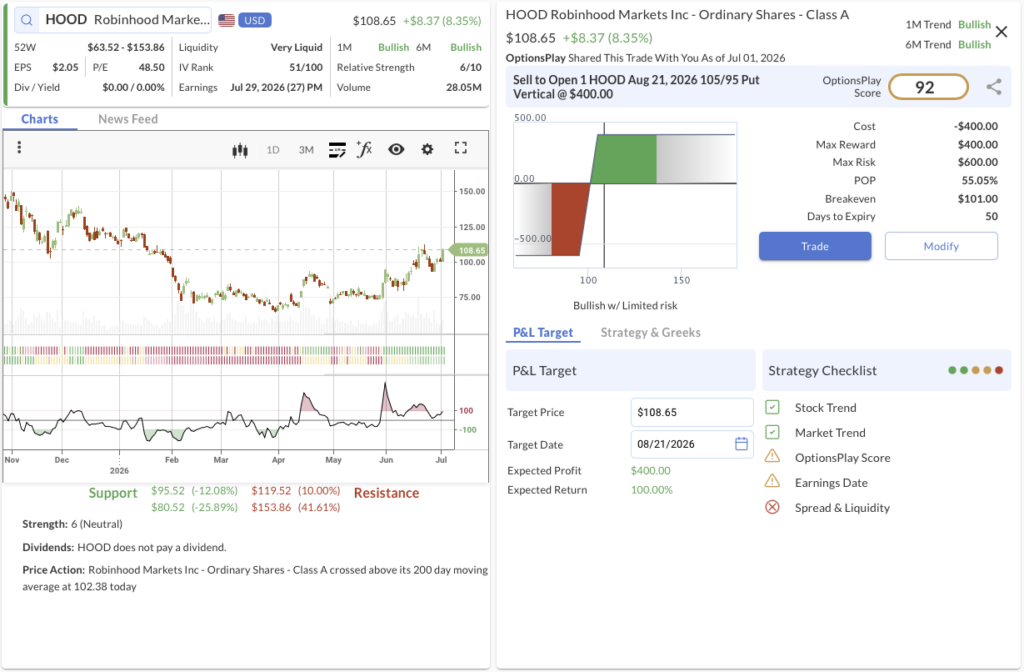
- We’re betting on: Record June trading volume is driving a wave of analyst price-target hikes across Wall Street, and for HOOD to stay above $105 by expiration to capture the full credit on this third add to two already-profitable positions.
- The Trade: Sell to Open the HOOD Aug 21, 2026 105/95 Put Vertical @ $4.00 Credit.
- 🔴 SELL TO OPEN Aug 21, 2026 105 Put @ $9.40
- 🟢 BUY TO OPEN Aug 21, 2026 95 Put @ $5.40
- Trade Metrics: POP: 55.05% | Collect $400 per contract vs. a Max Risk of $600 (1.50:1).
- The Setup: Shares surged 8.35% Wednesday on strong preliminary June metrics, reclaiming the 200-day moving average at $102.38 and flipping both trend flags to Bullish. Goldman Sachs raised its target to $121 and BTIG reiterated $125 after Robinhood’s “The World is Flat” event. Having already cleared our $108 target, this 105/95 short put vertical presses the two profitable positions already on the books (up a combined $1,072.50) for defined-risk exposure toward the extended $125 objective, with the $400 credit against $600 of risk sitting well inside resistance at $119.52.
- Management:
- ⚠️ Warning: Earnings are scheduled for Jul 29, 2026, potentially requiring active monitoring around the event.
- Stop Loss: Buy back the spread at $8.00 (100% loss of credit received).
- Take Profit: Buy back the spread at $2.00 (50% of max gain).
2. UNP ($277.73): New Highs, New Targets on Merger Progress

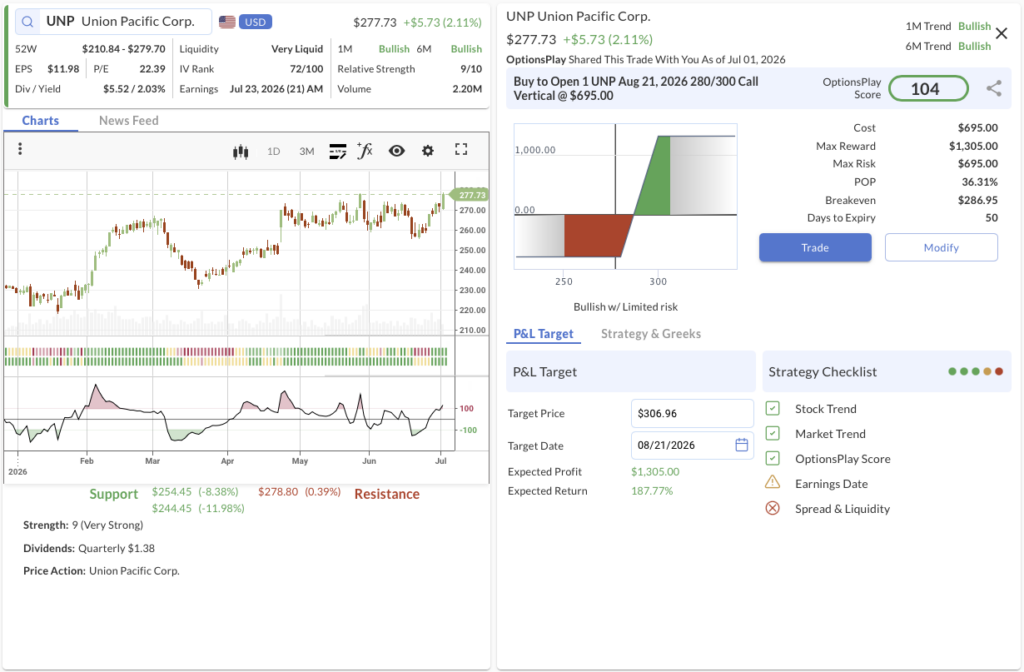
- We’re betting on: Union Pacific’s pending Norfolk Southern merger keeps drawing fresh price-target hikes from Wall Street, and for UNP to close above $300 by expiration to capture the full spread on this breakout to new highs.
- The Trade: Buy to Open the UNP Aug 21, 2026 280/300 Call Vertical @ $6.95 Debit.
- 🟢 BUY TO OPEN Aug 21, 2026 280 Call @ $11.10
- 🔴 SELL TO OPEN Aug 21, 2026 300 Call @ $4.15
- Trade Metrics: POP: 36.31% | Pay $695 per contract vs. a Max Reward of $1,305 (1.88:1).
- The Setup: Union Pacific broke out to a fresh 52-week high Wednesday, clearing the prior $270 resistance level on a 2.11% gain with a Relative Strength score of 9 out of 10. The breakout tracks a wave of price-target hikes tied to the pending $85 billion Norfolk Southern merger (Susquehanna to $305, Evercore ISI to $294, Jefferies to $300), backed by real operational execution: volumes up 2% with pricing still running above inflation. This 280/300 call vertical is structured for a 1.88:1 reward to risk, targeting our extended $300 objective by August expiration.
- Management:
- ⚠️ Warning: Earnings are scheduled for Jul 23, 2026, potentially requiring active monitoring around the event.
- Stop Loss: Sell the spread at $3.48 (50% loss on premium).
- Take Profit: Sell the spread at $12.16 (75% gain on premium).
EBAY, SE
OptionsPlay DailyPlay Ideas Menu – July 1st, 2026
What’s Driving The Market
- Q2 Ends at Record Highs: US equities closed the second quarter at records, with the Dow tagging a second straight all-time close at 52,319.20, the S&P 500 up 0.79% to 7,449.36, and the Nasdaq leading at +1.52% to 26,213.72. It capped the strongest three-month stretch since Q2 2020 (S&P +14.9%, Nasdaq +21.4%, Dow +12.9%), though breadth was solid rather than exceptional with six of eleven sectors green.
- Risk-On AI and Discretionary Leadership: Communication Services ripped +3.1% on mega-cap platforms and Alphabet’s Dow debut, Consumer Discretionary added +2.7% on travel, autos, and consumer tech, and Technology gained +1.7% as semiconductor sentiment kept repairing. Defensives lagged into quarter-end, with REITs notably weak (Digital Realty -4.2%), while Concentrix collapsed -22% on a double miss and Norfolk Southern fell -8.4% on downgrades.
- Hot JOLTS Stiffens the Fed’s Hold: JOLTS printed 7.6 million openings, a two-year high and about 600,000 above consensus, undercutting the soft-labor narrative even as the “jobs hard to get” subindex jumped to its highest since January 2021. The 10-year held near 4.38%, gold continued its sharp Q2 unwind (down about 14% to $4,036), and crude leaked toward $70 WTI and $73 Brent as US-Iran technical talks resumed in Doha.
- Nike’s Tariff-Flattered Print Sets the Consumer Tone: After the bell, Nike posted Q4 FY2026 revenue of $11.0B (-1% reported, -4% currency-neutral) and EPS of $0.72, with gross margin expanding about 890 bps on a roughly $986M one-time tariff refund tied to the Supreme Court duty ruling. NIKE Direct fell -7% and Greater China dropped -12%, framing a still-challenged consumer even as the refund flatters the headline and sets the early tone for discretionary into Wednesday.
💰 The Income Generators (High Probability, Cash Flow)
- EBAY: Sell a put vertical on a 9/10 marketplace leader breaking out of a base toward new highs.
- SE: Sell a put vertical on a multi-month base breakout in Southeast Asian e-commerce and fintech.
🚀 The Growth Seekers (Higher Risk, Max Reward)
- (No trades in this category today)
🛡️ The Portfolio Protectors (Hedges & Bearish Bets)
- (No trades in this category today)
1. EBAY ($111.75): Base Breakout Toward New Highs

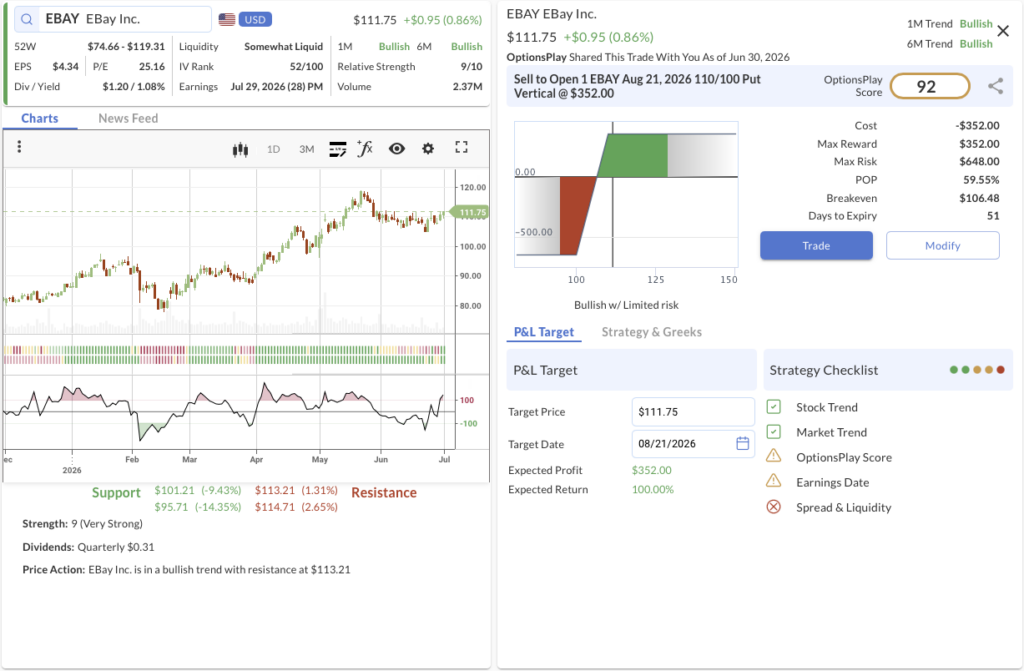
- We’re betting on: eBay’s marketplace re-acceleration and advertising momentum with a 9/10 relative-strength score as it breaks out of a base toward its 52-week high, and for EBAY to stay above $110 by expiration to capture the full credit.
- The Trade: Sell to Open the EBAY Aug 21, 2026 110/100 Put Vertical @ $3.52 Credit.
- 🔴 SELL TO OPEN Aug 21, 2026 110 Put
- 🟢 BUY TO OPEN Aug 21, 2026 100 Put
- Trade Metrics: POP: 59.56% | Collect $352 per contract vs. a Max Risk of $648 (1.84:1).
- The Setup: EBAY’s recent base around $105 looks constructive for a move toward its 52-week high after generating an early-breakout signal. The stock scores a strong 9/10 on relative strength with both its 1M and 6M trends bullish, a rare combination of value and momentum in a discretionary tape that just led the quarter. Selling the 110/100 put vertical collects $352 while defining risk below the $106.48 breakeven and just under the reclaimed $105 base. With 52 days to expiry and a 59.56% probability of profit, time decay works in our favor as long as EBAY holds above $110.
- Management:
- ⚠️ Warning: Earnings are scheduled for July 29, 2026, potentially requiring active monitoring around the event.
- Stop Loss: Buy back the spread at $7.04 (100% loss of credit received).
- Take Profit: Buy back the spread at $1.76 (50% of max gain).
2. SE ($95.83): Multi-Month Base Breakout

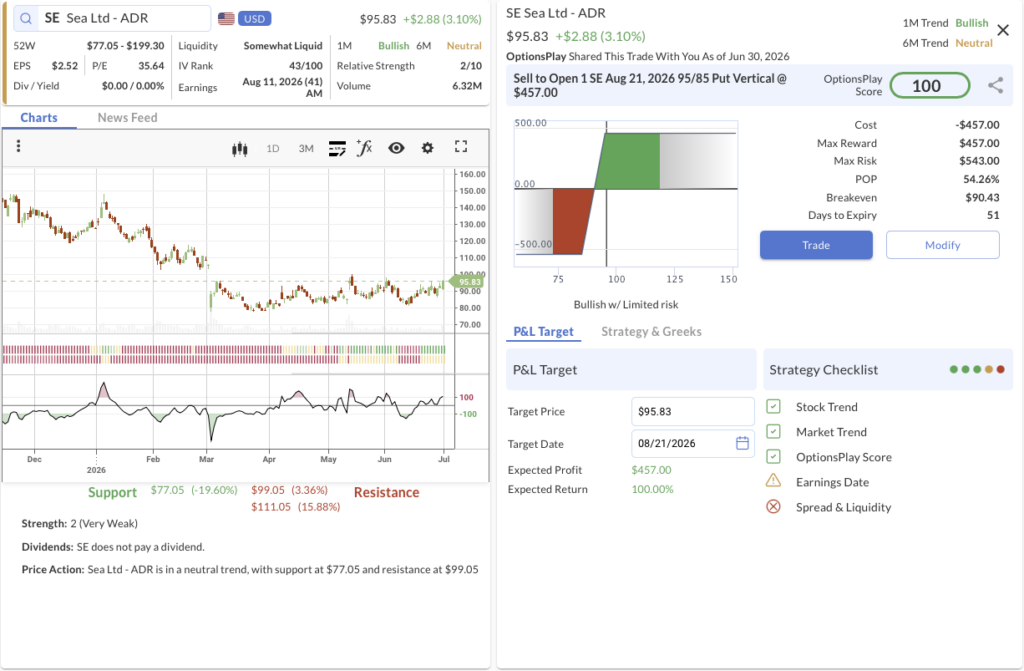
- We’re betting on: Sea Limited’s turn to profitability across Shopee e-commerce, digital financial services, and Garena gaming as it breaks out of a multi-month base, and for SE to stay above $95 by expiration to capture the full credit.
- The Trade: Sell to Open the SE Aug 21, 2026 95/85 Put Vertical @ $4.57 Credit.
- 🔴 SELL TO OPEN Aug 21, 2026 95 Put @ $8.52
- 🟢 BUY TO OPEN Aug 21, 2026 85 Put @ $3.95
- Trade Metrics: POP: 54.26% | Collect $457 per contract vs. a Max Risk of $543 (1.19:1).
- The Setup: SE has been building a significant base for multiple months as it bottoms and now potentially breaks out, triggering our early-breakout detector toward the $110 target. The 1M trend is bullish, though relative strength is still weak at 2/10 with a neutral 6M trend, so this is an early base breakout where selling defined-risk premium fits better than buying the move. Selling the 95/85 put vertical collects $457 while defining risk below the $90.43 breakeven and well above the $77.05 support. With 52 days to expiry and a 54.26% probability of profit, time decay works in our favor as long as SE holds above $95.
- Management:
- ⚠️ Warning: Earnings are scheduled for August 11, 2026, potentially requiring active monitoring around the event.
- Stop Loss: Buy back the spread at $9.14 (100% loss of credit received).
- Take Profit: Buy back the spread at $2.29 (50% of max gain).
AXON, RKT
OptionsPlay DailyPlay Ideas Menu – June 30th, 2026
What’s Driving The Market
- Alphabet Joins the Dow, Index Hits 52,000: Alphabet officially joined the Dow Jones Industrial Average before the open, replacing Verizon, and rallied nearly 5% on its debut, helping push the Dow to its first-ever close above 52,000 at 52,182.74 (+0.59%), the S&P 500 to a record 7,440.43 (+1.18%), and the Nasdaq to a leading 25,820.14 (+2.07%). Communication Services, Consumer Discretionary, and Technology carried the tape.
- The AI Trade Re-Accelerated: The VanEck Semiconductor ETF gained more than 3% (Astera Labs +16%, KLA about +12%, Applied Materials about +11%), while Tesla surged about 8.5% on robotaxi enthusiasm and Amazon (+3.2%), Meta (+2.2%), and NVDA (+1.3%) shook off the recent multi-week selloff. Comcast rose 4.4% on a plan to spin its media and tech businesses into two publicly traded companies, fitting the broader conglomerate-breakup theme.
- Alphabet’s $84.75B Raise Anchors AI Capex Visibility: Beyond the index rebalance, GOOGL is pricing what is described as the largest equity capital raise in US corporate history, an $84.75 billion offering anchored by a $10 billion Berkshire Hathaway private placement, combining a $30 billion public offering with a $40 billion at-the-market program starting in Q3 to fund a multi-year AI buildout through 2027. That is a meaningful re-rating for AI capex visibility and the hyperscaler-adjacent semis that gapped higher today.
- Two Macro Overhangs Eased: The Supreme Court ruled 5-4 that the administration cannot remove Fed Governor Lisa Cook while her legal challenge proceeds, a clean defense of central-bank independence the bond market took as marginally constructive (10-year roughly flat near 4.36%). US-Iran tensions also de-escalated over the weekend, with both sides agreeing to halt tit-for-tat attacks and talks set to resume Tuesday, lifting WTI to $69.70 and Brent to about $72.50 off four-month lows. Small caps lagged, a reminder this was a megacap-led, rebalance-aided rally rather than a broadening.
💰 The Income Generators (High Probability, Cash Flow)
- AXON: Sell a put vertical to press a confirmed-outperformer winner breaking out above $500.
- RKT: Sell a put vertical on an early breakout at the crossroads of two strengthening sectors.
🚀 The Growth Seekers (Higher Risk, Max Reward)
- (No trades in this category today)
🛡️ The Portfolio Protectors (Hedges & Bearish Bets)
- (No trades in this category today)
1. AXON ($510.60): Pressing a Winner Through $500

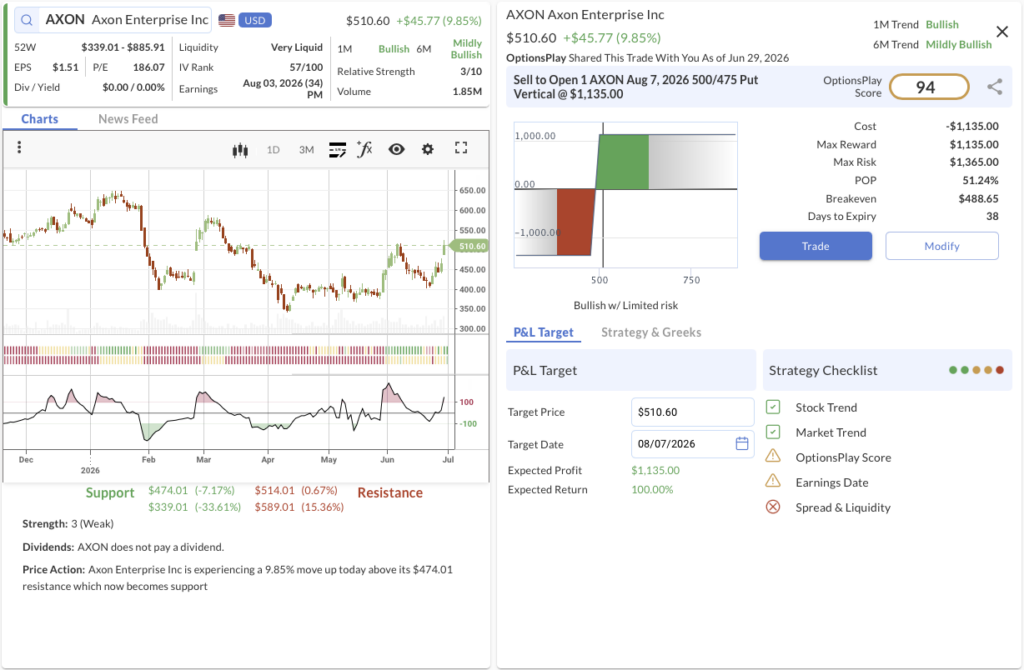
- We’re betting on: Axon’s recurring-software and law-enforcement-tech dominance as it confirms outperformer status above $500, pressing a winner already up about 49%, and for AXON to stay above $500 by expiration to capture the full credit.
- The Trade: Sell to Open the AXON Aug 7, 2026 500/475 Put Vertical @ $11.35 Credit.
- 🔴 SELL TO OPEN Aug 7, 2026 500 Put @ $44.45
- 🟢 BUY TO OPEN Aug 7, 2026 475 Put @ $33.10
- Trade Metrics: POP: 51.25% | Collect $1,135 per contract vs. a Max Risk of $1,365 (1.20:1).
- The Setup: This is the press-the-winner discipline: our June 2 AXON position, the 460/430 put credit spread, is up about 49%, and AXON’s breakout above $500 on strong volume with confirmed-outperformer status is the signal to add. The 1M trend is bullish, though relative strength is still catching up at 3/10 after a deep first-half drawdown, so we add by selling defined-risk premium rather than chasing. Selling the 500/475 put vertical collects $1,135 while defining risk below the $488.65 breakeven and the $474.01 support, with the $635 upside still in view. With 39 days to expiry and a 51.25% probability of profit, time decay works in our favor as long as AXON holds above $500.
- Management:
- ⚠️ Warning: Earnings are scheduled for August 3, 2026, potentially requiring active monitoring around the event.
- Stop Loss: Buy back the spread at $22.70 (100% loss of credit received).
- Take Profit: Buy back the spread at $5.68 (50% of max gain).
2. RKT ($15.50): Early Breakout at a Sector Crossroads

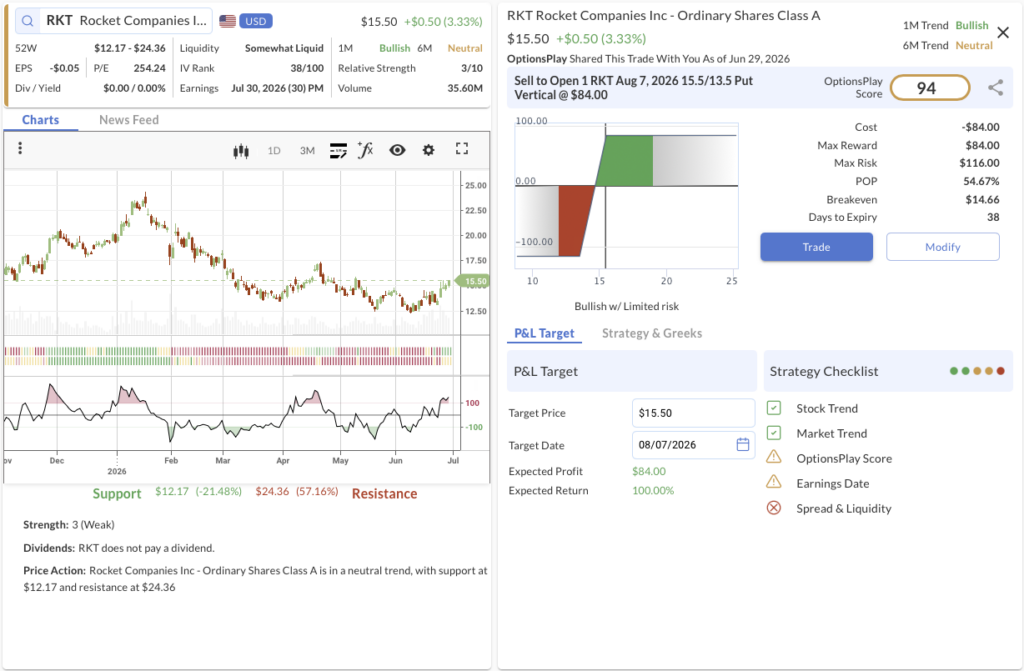
- We’re betting on: Rocket Companies’ mortgage and fintech leverage at the intersection of two strengthening sectors as it triggers an early breakout, and for RKT to stay above $15.50 by expiration to capture the full credit.
- The Trade: Sell to Open the RKT Aug 7, 2026 15.5/13.5 Put Vertical @ $0.84 Credit.
- 🔴 SELL TO OPEN Aug 7, 2026 15.5 Put @ $1.42
- 🟢 BUY TO OPEN Aug 7, 2026 13.5 Put @ $0.58
- Trade Metrics: POP: 54.67% | Collect $84 per contract vs. a Max Risk of $116 (1.38:1).
- The Setup: RKT triggered our early-breakout signal and sits at the intersection of two strengthening sectors, financials and housing, on its way toward the $17.50 target. The 1M trend is bullish on a 3.33% move, though relative strength is still weak at 3/10 with a neutral 6M trend, so this is an early-stage breakout where selling defined-risk premium fits better than buying the move. Selling the 15.5/13.5 put vertical collects $84 while defining risk below the $14.66 breakeven and the $12.17 support. With 39 days to expiry and a 54.67% probability of profit, time decay works in our favor as long as RKT holds above $15.50.
- Management:
- ⚠️ Warning: Earnings are scheduled for July 30, 2026, potentially requiring active monitoring around the event.
- Stop Loss: Buy back the spread at $1.68 (100% loss of credit received).
- Take Profit: Buy back the spread at $0.42 (50% of max gain).
MO, BKNG, KKR
OptionsPlay DailyPlay Ideas Menu – June 29th, 2026
💰 The Income Generators (High Probability, Cash Flow)
- MO: Sell a put vertical on a 9/10 leader on the verge of a new 52-week high.
🚀 The Growth Seekers (Higher Risk, Max Reward)
- BKNG: Long call vertical adding to a winning position breaking out to a new relative high.
🛡️ The Portfolio Protectors (Hedges & Bearish Bets)
- KKR: Long put vertical adding to a winning short as it breaks below $92.50 support.
1. MO ($73.79): Selling Premium Into a New-High Breakout

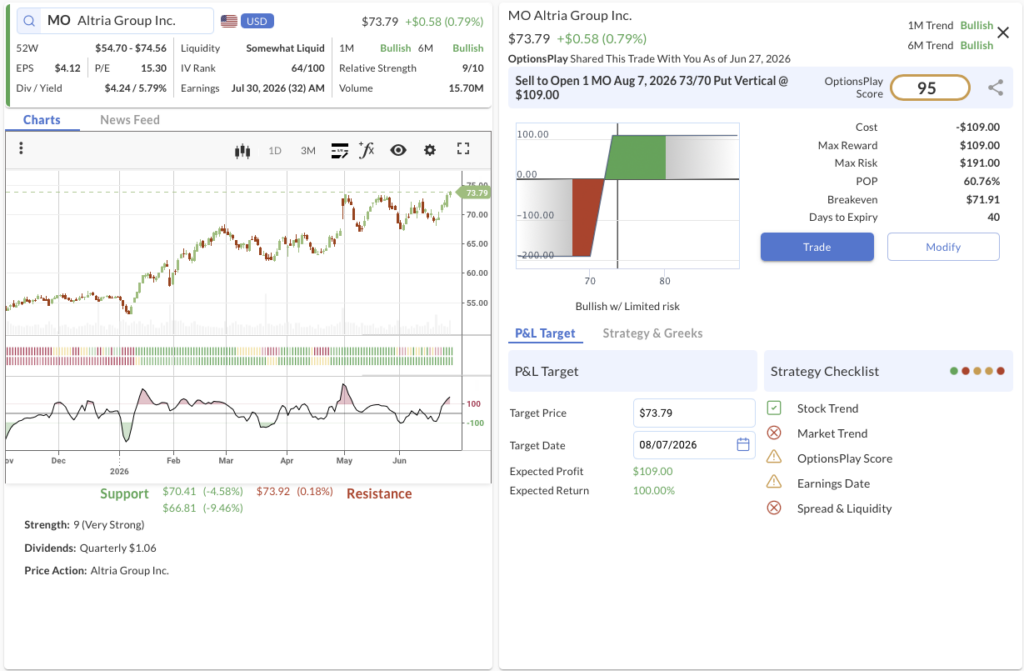
- We’re betting on: Altria’s resilient cash-generative tobacco franchise and 5.8% dividend leadership as it pushes toward a new 52-week high, and for MO to stay above $73 by expiration to capture the full credit.
- The Trade: Sell to Open the MO Aug 7, 2026 73/70 Put Vertical @ $1.09 Credit.
- 🔴 SELL TO OPEN Aug 7, 2026 73 Put @ $2.19
- 🟢 BUY TO OPEN Aug 7, 2026 70 Put @ $1.10
- Trade Metrics: POP: 60.76% | Collect $109 per contract vs. a Max Risk of $191 (1.75:1).
- The Setup: MO is outperforming and on the verge of a potential breakout to a new 52-week high on strong volume. The stock scores 9/10 on relative strength with both its 1M and 6M trends bullish, a rare combination of defensive yield and momentum as capital rotates toward steady-cash-flow names. Selling the 73/70 put vertical collects premium while defining risk below the $71.91 breakeven and the $70.41 support. With 41 days to expiry and a 60.81% probability of profit, time decay works in our favor as long as MO holds above $73.
- Management:
- ⚠️ Warning: Earnings are scheduled for July 30, 2026, potentially requiring active monitoring around the event.
- Stop Loss: Buy back the spread at $2.18 (100% loss of credit received).
- Take Profit: Buy back the spread at $0.55 (50% of max gain).
2. BKNG ($181.46): Pressing a Travel Winner to New Highs

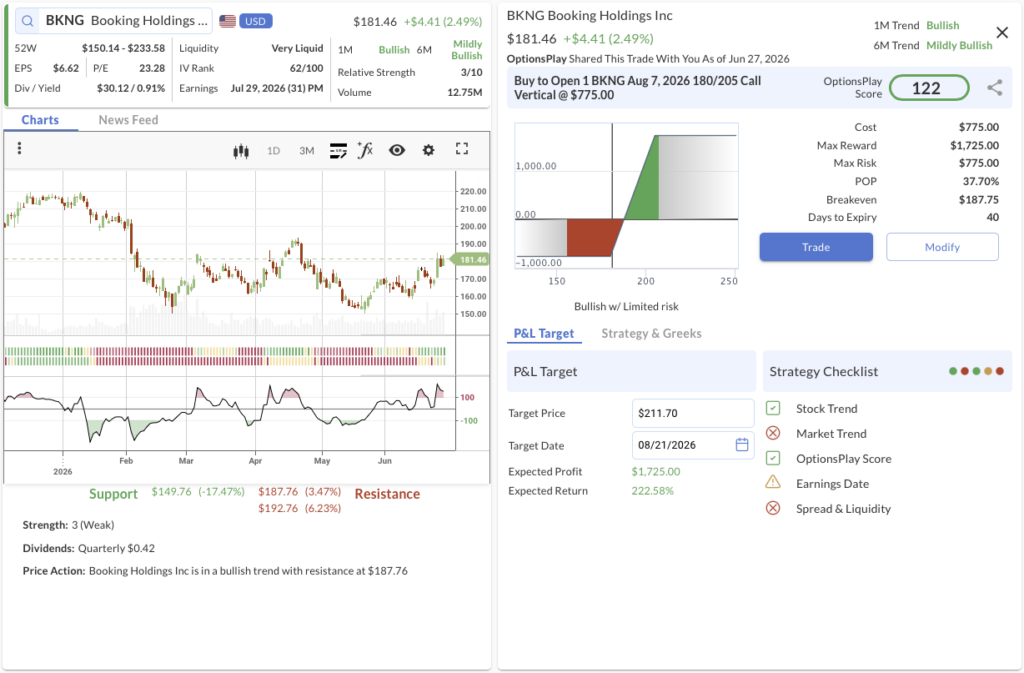
- We’re betting on: Booking Holdings’ global travel-demand leadership and aggressive buybacks, pressing a winner already up about 44%, and for BKNG to close above $205 by expiration to capture the full spread.
- The Trade: Buy to Open the BKNG Aug 7, 2026 180/205 Call Vertical @ $7.75 Debit.
- 🟢 BUY TO OPEN Aug 7, 2026 180 Call @ $11.40
- 🔴 SELL TO OPEN Aug 7, 2026 205 Call @ $3.65
- Trade Metrics: POP: 37.70% | Pay $775 per contract vs. a Max Reward of $1,725 (2.23:1).
- The Setup: This is the press-the-winner discipline: our June 17 BKNG position, the 175/195 call vertical, is up about 44%, and BKNG just broke out to a new relative high with an upgrade to our building-outperformance list as consumer names outperform. The 1M trend is bullish on the breakout, though relative strength is still catching up at 3/10, so we add defined-risk upside rather than chase. The 180/205 call vertical captures the continuation with a breakeven at $187.75 and support at $149.76, with a close above $205 at expiration delivering the full reward.
- Management:
- ⚠️ Warning: Earnings are scheduled for July 29, 2026, potentially requiring active monitoring around the event.
- Stop Loss: Sell the spread at $3.88 (50% loss of premium).
- Take Profit: Sell the spread at $13.53 (75% gain on premium).
3. KKR ($90.13): Pressing the Short Below $92.50

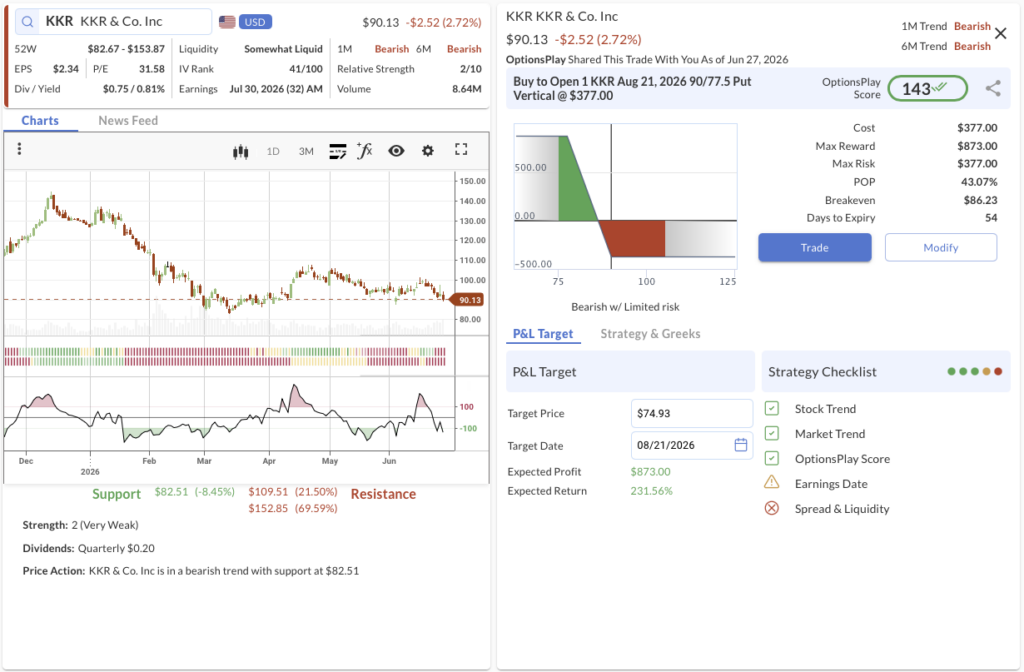
- We’re betting on: KKR’s deteriorating momentum as it breaks support and joins our early-underperform group, pressing a short already up about 27%, and for KKR to fall below $77.50 by expiration to capture the full spread.
- The Trade: Buy to Open the KKR Aug 21, 2026 90/77.5 Put Vertical @ $3.77 Debit.
- 🟢 BUY TO OPEN Aug 21, 2026 90 Put @ $5.50
- 🔴 SELL TO OPEN Aug 21, 2026 77.5 Put @ $1.73
- Trade Metrics: POP: 43.07% | Pay $377 per contract vs. a Max Reward of $873 (2.32:1).
- The Setup: This is the press-the-winner discipline on the short side: our June 4 KKR position, the 92.5/100 bearish call spread, is up about 27%, and KKR just broke below its $92.50 support and joined our early-underperform group, targeting $82 to the downside. The stock scores just 2/10 on relative strength with both its 1M and 6M trends bearish, mired below a falling 50-day average. The 90/77.5 put vertical captures the move lower with defined risk, a breakeven at $86.23, and resistance overhead at $109.51, with a close below $77.50 at expiration delivering the full reward.
- Management:
- ⚠️ Warning: Earnings are scheduled for July 30, 2026, potentially requiring active monitoring around the event.
- Stop Loss: Sell the spread at $1.89 (50% loss of premium).
- Take Profit: Sell the spread at $6.60 (75% gain on premium).
ABT, MRK
OptionsPlay DailyPlay Ideas Menu – June 26th, 2026
What’s Driving The Market
- Mag7 Split-Screen, Apple’s Worst Day in a Year: Apple fell 6.13%, its worst single session in over a year, after announcing the first formal pass-through of memory and storage cost inflation to consumers, raising MacBook and iPad list prices by as much as 25% while holding the line on iPhone, Watch, and AirPods. CEO Tim Cook called the move unavoidable, saying the company had never seen a component price increase this much this quickly, and Microsoft followed with Xbox hardware price hikes (-3.23%). The rest of the cohort leaned negative, with Nvidia, Oracle, Amazon, Alphabet, and Microsoft all down more than 2%.
- Qualcomm Reframes as AI Infrastructure: QCOM ran as high as +11% to $219 intraday before settling +5% near $207 after its Investor Day doubled the FY29 non-handset revenue target to $40B from $22B (over $15B data center, about $10B automotive, over $14B IoT). It also landed Meta as its first named hyperscale data-center CPU customer and announced a roughly $4B all-stock acquisition of AI software startup Modular, positioned against NVIDIA’s CUDA moat. The size of the move showed how under-positioned the buyside was for the shift from smartphone IP to AI infrastructure.
- Micron Extends, Memory Super-Cycle Confirmed: MU continued higher after Wednesday’s blowout (revenue $41.456B vs $35.59B consensus, +346% year over year, a Q4 guide near $50B vs $42.9B, gross margin 84.9%, 16 long-term agreements, and HBM fully booked beyond 2027), the cleanest AI capex confirmation in months. The irony is sharp: the same memory shortage powering Micron is now squeezing Apple’s margins with no near-term hedge.
- Rotation Under the Surface as Oil’s War Premium Clears: The Dow held with 9 of 10 top names advancing (Caterpillar +4.04%, Goldman +1.15%) and the Russell 2000 rose 1.23% against the Nasdaq’s -0.46%, the cleanest rotation reading in weeks, as industrials, financials, and health care led. WTI fell below $70 for a fourth straight session (range $69.65 to $73.17) as Hormuz tanker traffic recovered and Brent broke decisively below $95, keeping energy-driven inflation pass-through contained even as core PCE drifts higher and the Fed stays on hold (July no-change odds near 89%).
💰 The Income Generators (High Probability, Cash Flow)
- ABT: Sell a put vertical to establish a starter position on a med-tech breakout above $90.
🚀 The Growth Seekers (Higher Risk, Max Reward)
- MRK: Long call vertical adding upside to a winning Merck position breaking out above $125.
🛡️ The Portfolio Protectors (Hedges & Bearish Bets)
- (No trades in this category today)
1. ABT ($93.24): Starter Position on the $90 Breakout

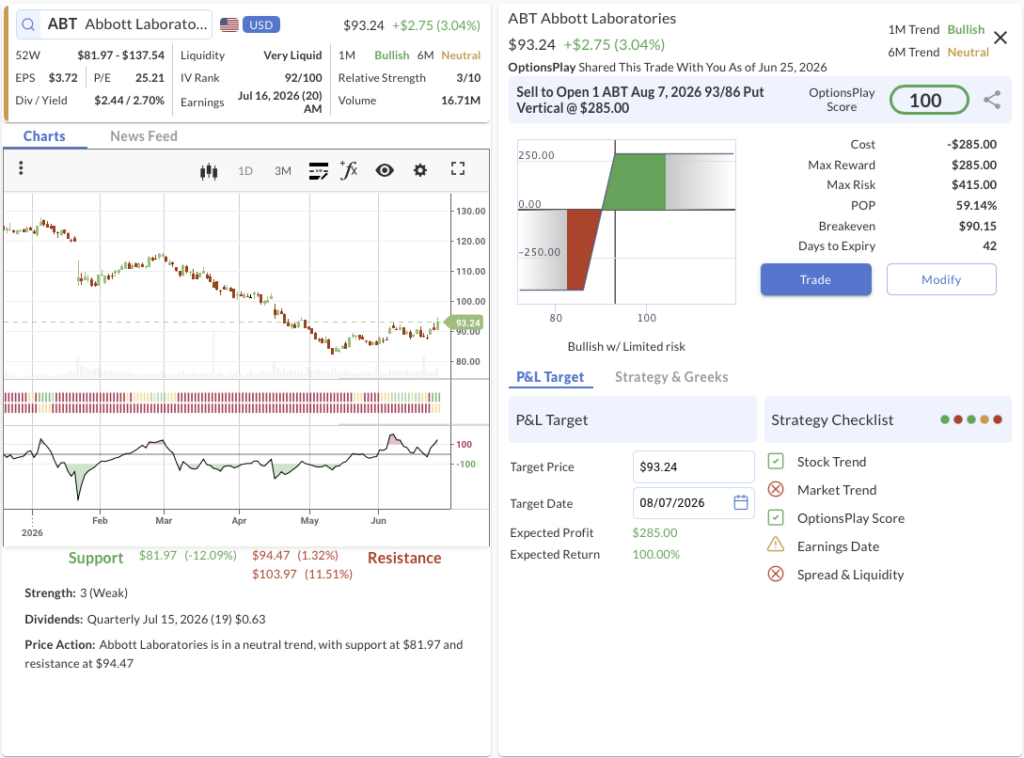
- We’re betting on: Abbott’s diversified med-tech, diagnostics, and nutrition franchise stabilizing as it breaks out above $90, and for ABT to stay above $93 by expiration to capture the full credit.
- The Trade: Sell to Open the ABT Aug 7, 2026 93/86 Put Vertical @ $2.85 Credit.
- 🔴 SELL TO OPEN Aug 7, 2026 93 Put @ $4.35
- 🟢 BUY TO OPEN Aug 7, 2026 86 Put @ $1.50
- Trade Metrics: POP: 59.15% | Collect $285 per contract vs. a Max Risk of $415 (1.46:1).
- The Setup: ABT recently broke out above its $90 level and triggered our early-breakout detector, warranting a starter position to see if it can move toward the $115 target. Relative strength is still weak at 3/10 with a neutral 6M trend, so this is an early-stage turnaround, which is why we establish exposure by selling defined-risk premium rather than buying the move outright. Selling the 93/86 put vertical collects $285 while defining risk below the $90.15 breakeven and just above the $81.97 support. With 43 days to expiry and a 59.15% probability of profit, time decay works in our favor as long as ABT holds above $93.
- Management:
- ⚠️ Warning: Earnings are scheduled for July 16, 2026, potentially requiring active monitoring around the event.
- Stop Loss: Buy back the spread at $5.70 (100% loss of credit received).
- Take Profit: Buy back the spread at $1.43 (50% of max gain).
2. MRK ($125.45): Pressing a Pharma Winner Through $125

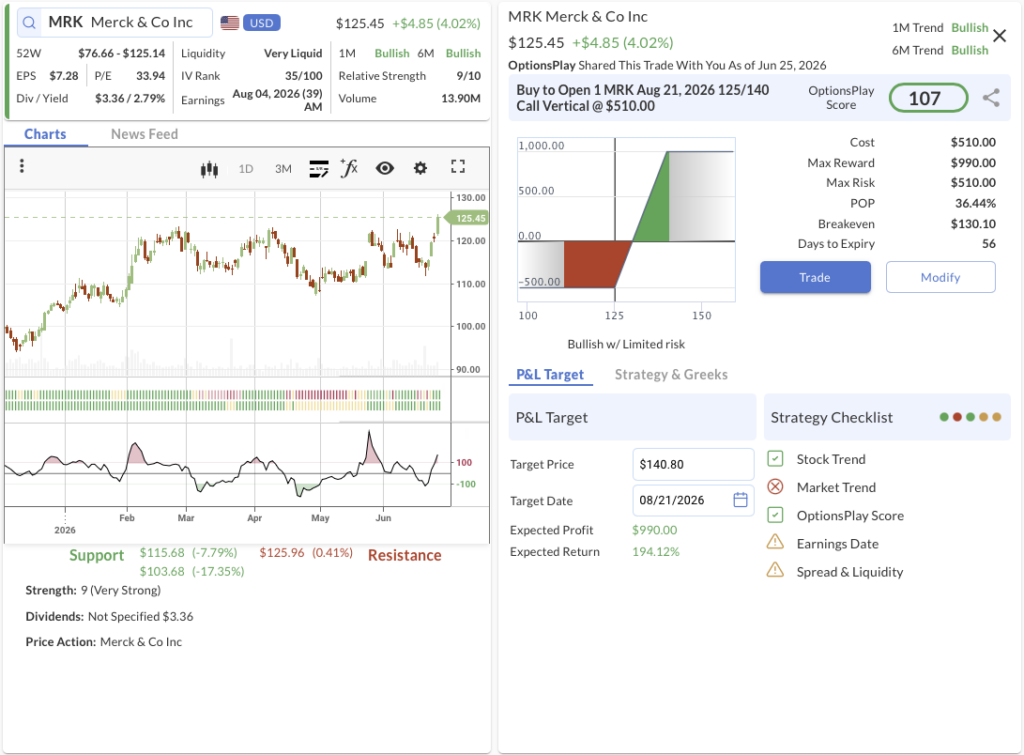
- We’re betting on: Merck’s deep oncology and vaccine franchise re-rating on its breakout above $125, pressing a winner already up about 20%, and for MRK to close above $140 by expiration to capture the full spread.
- The Trade: Buy to Open the MRK Aug 21, 2026 125/140 Call Vertical @ $5.10 Debit.
- 🟢 BUY TO OPEN Aug 21, 2026 125 Call @ $6.63
- 🔴 SELL TO OPEN Aug 21, 2026 140 Call @ $1.53
- Trade Metrics: POP: 36.45% | Pay $510 per contract vs. a Max Reward of $990 (1.94:1).
- The Setup: This is the press-the-winner discipline: our May 26 MRK position, the 122/115 put credit spread, is up about 20%, and MRK just broke out above $125 on strong volume with a fresh early-breakout scan, the signal to add directional upside. The stock scores 9/10 on relative strength with both its 1M and 6M trends bullish, backed by its durable Keytruda oncology engine and Gardasil vaccine franchise. The 125/140 call vertical captures the move toward the $140 target with defined risk, a breakeven at $130.10, and support at $115.68, with a close above $140 at expiration delivering the full reward.
- Management:
- ⚠️ Warning: Earnings are scheduled for August 4, 2026, potentially requiring active monitoring around the event.
- Stop Loss: Sell the spread at $2.55 (50% loss of premium).
- Take Profit: Sell the spread at $8.93 (75% gain on premium).
RCL, SPG
OptionsPlay DailyPlay Ideas Menu – June 25th, 2026
What’s Driving The Market
- Oil Was the Dominant Driver, Not Equities: WTI briefly broke below $70 intraday for the first time since March 2 and Brent settled down 4.3% at $73.74 as Hormuz tanker traffic kept climbing after the June 17 US-Iran MOU and the renewed Israel/Hezbollah ceasefire. As normalized throughput bleeds off the war-risk premium, the tape moved mechanically: energy was the worst sector, the 10-year yield collapsed 11 bps to 4.39% as inflation breakevens compressed, the VIX fell another 4.4% to 18.63, and the long-duration debasement hedges (gold -3.61% to $3,999.80, bitcoin -1.9%) all sold off in unison.
- Equity Dispersion Was the Real Story: Headline indices were quiet (S&P -0.10%, Nasdaq -0.43%, Dow +0.35%, Russell +0.37%), but the rotation underneath was violent. The Dow’s outperformance came from defensive, value-tilted names insulated from both the energy unwind and the semi de-risking, while the Nasdaq’s weakness was almost entirely a chip story as traders cut exposure ahead of Micron’s after-hours print. Real estate and rate-sensitive groups got a bid on the duration rally, and small-caps eked out a gain on the combination of lower yields and cheaper input costs.
- Micron Blew the Lid Off the AI-Memory Narrative: MU reported Q3 EPS of $25.11 versus $20.39 consensus and revenue of $41.5B versus $35.1B, a roughly $6.4B beat, with adjusted gross margin of 84.9%, a new $0.15 quarterly dividend, and Q4 revenue guided to $49 to $51B versus the $43.2B Street midpoint. The stock jumped more than 6% after hours and pulled the broader chip complex higher in extended trade, setting up Thursday’s open as a referendum on whether the HBM and AI-memory super-cycle thesis is still intact.
- Single-Stock Moves and the Fed Backdrop: IBM extended gains after Tuesday’s JPMorgan upgrade to overweight, Qualcomm stayed under pressure on reported talks to acquire AI software firm Modular, and Oracle remained heavy after disclosing 21,000 job cuts. Wednesday’s bond rally was the energy and breakeven channel doing the work the Warsh Fed cannot, with fed funds futures still implying no cuts before year-end ahead of Friday’s May PCE print.
💰 The Income Generators (High Probability, Cash Flow)
- RCL: Sell a put vertical to press a winning cruise position breaking out above $300.
🚀 The Growth Seekers (Higher Risk, Max Reward)
- SPG: Long call vertical adding to a winning mall-REIT position at new 52-week highs, targeting $250.
🛡️ The Portfolio Protectors (Hedges & Bearish Bets)
- (No trades in this category today)
1. RCL ($320.95): Pressing a Cruise Winner Through $300

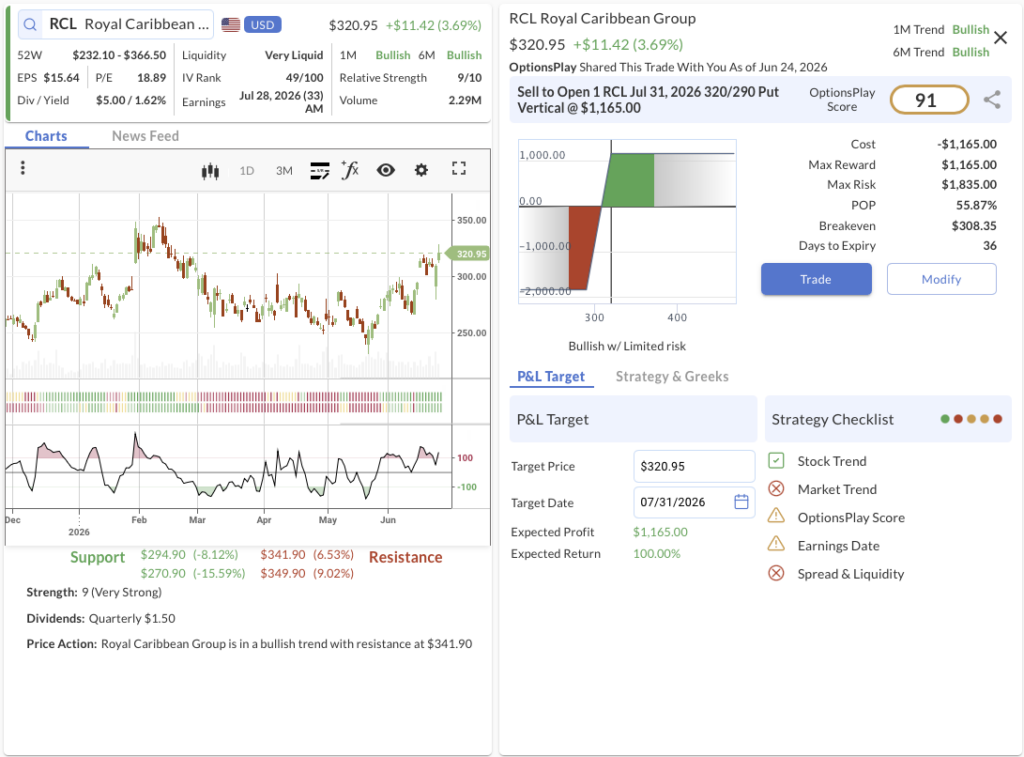
- We’re betting on: Royal Caribbean’s record booking demand as travel keeps outperforming, pressing a winner already up about 19% on its breakout above $300 and upgrade to our building-outperformance list, and for RCL to stay above $320 by expiration to capture the full credit.
- The Trade: Sell to Open the RCL Jul 31, 2026 320/290 Put Vertical @ $11.65 Credit.
- 🔴 SELL TO OPEN Jul 31, 2026 320 Put @ $20.35
- 🟢 BUY TO OPEN Jul 31, 2026 290 Put @ $8.70
- Trade Metrics: POP: 55.88% | Collect $1,165 per contract vs. a Max Risk of $1,835 (1.58:1).
- The Setup: This is the press-the-winner discipline: our June 16 RCL position, the 310/350 call vertical, is up about 19%, and RCL’s breakout above $300 with an upgrade to our building-outperformance list is the signal to add. The stock scores 8/10 on relative strength with both its 1M and 6M trends bullish as travel and cruise demand keep outperforming. Rather than chase with another debit, we sell the 320/290 put vertical to collect $1,165 and define risk below the $308.35 breakeven and the $294.90 support. With 37 days to expiry and a 55.88% probability of profit, time decay works in our favor as long as RCL holds above $320.
- Management:
- ⚠️ Warning: Earnings are scheduled for July 28, 2026, potentially requiring active monitoring around the event.
- Stop Loss: Buy back the spread at $23.30 (100% loss of credit received).
- Take Profit: Buy back the spread at $5.83 (50% of max gain).
2. SPG ($222.15): Pressing a REIT Winner to New Highs

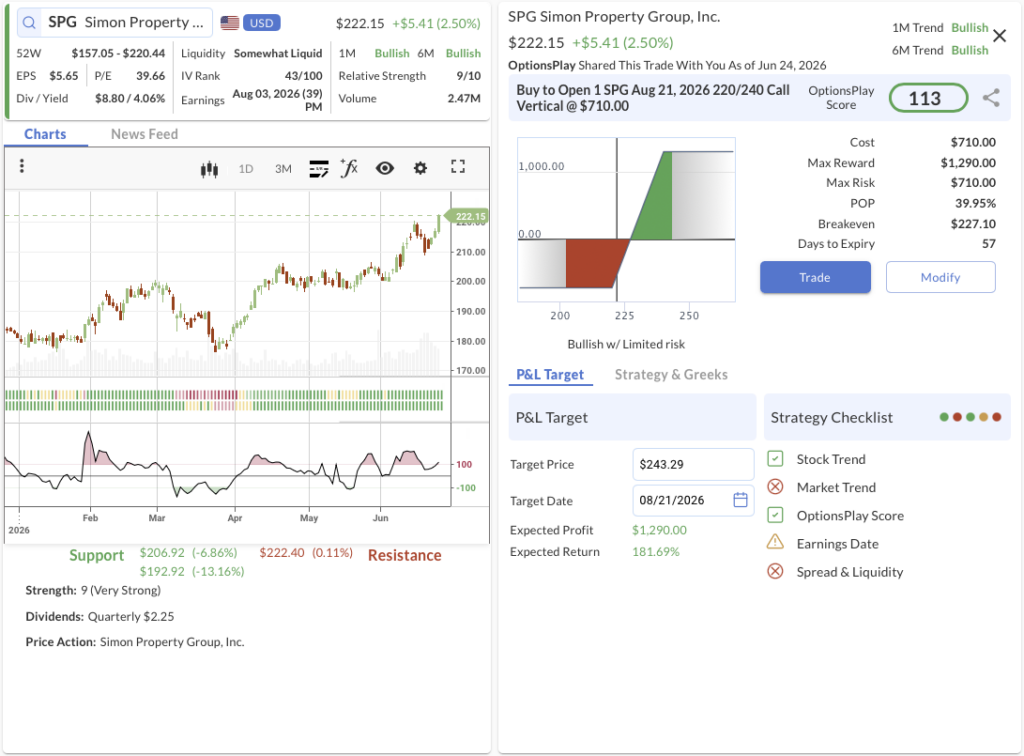
- We’re betting on: Simon Property’s best-in-class mall REIT leadership as real estate outperforms, pressing a winner already up 66% on its breakout to new 52-week highs, and for SPG to close above $240 by expiration to capture the full spread.
- The Trade: Buy to Open the SPG Aug 21, 2026 220/240 Call Vertical @ $7.10 Debit.
- 🟢 BUY TO OPEN Aug 21, 2026 220 Call @ $9.45
- 🔴 SELL TO OPEN Aug 21, 2026 240 Call @ $2.35
- Trade Metrics: POP: 39.97% | Pay $710 per contract vs. a Max Reward of $1,290 (1.82:1).
- The Setup: This is the press-the-winner discipline: our June 10 SPG position, the 210/230 call vertical, is already up 66%, and SPG’s breakout to new 52-week highs with an upgrade to our building-outperformance list is the signal to add further upside. The stock scores 9/10 on relative strength with both its 1M and 6M trends bullish as real estate outperforms on the duration rally. The 220/240 call vertical captures the continuation toward the $250 target with defined risk, a breakeven at $227.10, and support at $207, with a close above $240 at expiration delivering the full reward.
- Management:
- ⚠️ Warning: Earnings are scheduled for August 3, 2026, potentially requiring active monitoring around the event.
- Stop Loss: Sell the spread at $3.55 (50% loss of premium).
- Take Profit: Sell the spread at $12.43 (75% gain on premium).
DASH, ARM
OptionsPlay DailyPlay Ideas Menu – June 24th, 2026
What’s Driving The Market
- Risk-Off Reversal Imported From Asia: South Korea’s KOSPI fell roughly 10% overnight, triggering programmatic circuit-breaker halts twice in a single session, as Samsung and SK Hynix both plunged more than 12% and Kioxia tumbled over 15%. The trigger was a mix of stretched AI-leveraged positioning, regulatory scrutiny of semiconductor-linked structured products, and fatigue around AI capex monetization after Broadcom’s guide disappointed, with foreign investors net-selling about 5.79 trillion won ($3.8 billion) of Korean equities.
- US Semis Caught the Handoff: The Philadelphia Semiconductor Index led the Nasdaq lower (-2.21%) as Western Digital (-8.4%), Qualcomm (-6.9%), AVGO (-3.06%), and NVDA all sold. NVDA had been the only major chip name to close higher Monday after the AVGO guide, and that single-name leadership dissolved Tuesday as the rout broadened.
- The BofA Hawkish Pivot (our read: too hawkish): BofA economist Aditya Bhave published one of the year’s most hawkish calls, forecasting three consecutive 25 bp hikes in September, October, and December for a cumulative +75 bps to 4.25 to 4.50%, versus only about 42 bps the market is pricing. Our read is that this view treats inflation risk as too high, particularly with crude making fresh three-month lows, which cuts against the hawkish thesis on the margin.
- Defensive Rotation and a Vol Spike: The Dow held (-0.09%) against the Nasdaq’s -2.21% drubbing, with Bank of America itself printing an all-time closing high at $57.91 on the curve-steepening implication of its own rate call. Defensives caught the bid (Public Storage +4.4%, IBM +4.2%, Accenture +3.3%), and the VIX surged 12.79% to 19.49, its first close back above 19 in weeks.
- Oil Cross-Current: WTI fell to roughly $73.40 to $74 and Brent to $77.20 to $78, both three-month lows, after the US Treasury issued Iran General License X, a 60-day waiver authorizing production, delivery, and sale of Iranian crude through August 21 and permitting USD-denominated transactions for the first time in nearly two decades. Falling crude is supportive for headline inflation near term and undercuts the most hawkish rate calls.
💰 The Income Generators (High Probability, Cash Flow)
- DASH: Sell a put vertical on a DoorDash breakout above $165, collecting premium with the $210 target in view.
- ARM: Sell a put vertical into elevated semiconductor volatility, collecting rich premium below the 26-day EMA.
🚀 The Growth Seekers (Higher Risk, Max Reward)
- (No trades in this category today)
🛡️ The Portfolio Protectors (Hedges & Bearish Bets)
- (No trades in this category today)
1. DASH ($171.52): Selling Premium on the $165 Breakout

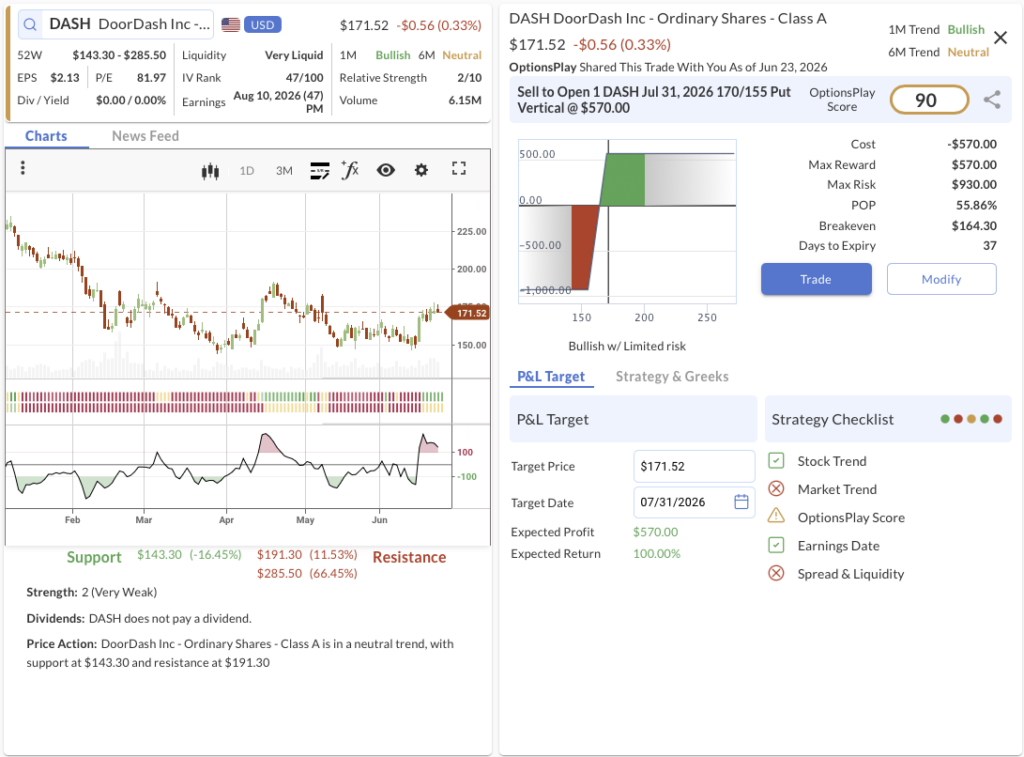
- We’re betting on: DoorDash’s compelling growth and profitability inflection, with Q1 revenue up 33% to $4B, record orders, and positive GAAP net income, and for DASH to stay above $170 by expiration to capture the full credit.
- The Trade: Sell to Open the DASH Jul 31, 2026 170/155 Put Vertical @ $5.70 Credit.
- 🔴 SELL TO OPEN Jul 31, 2026 170 Put @ $10.30
- 🟢 BUY TO OPEN Jul 31, 2026 155 Put @ $4.60
- Trade Metrics: POP: 55.86% | Collect $570 per contract vs. a Max Risk of $930 (1.63:1).
- The Setup: DASH recently broke out above its $165 level on a bullish 1M trend, setting up for a potential move toward the $210 target, though the $185 major resistance stands in the way. Relative strength is still weak at 2/10 with a neutral 6M trend, so this is an early turnaround rather than an established leader, which is why we sell premium with defined risk instead of buying the move outright. Selling the 170/155 put vertical collects $570 while defining risk below the $164.30 breakeven, just under the breakout and well above the $143 support. With 38 days to expiry and a 55.86% probability of profit, time decay works in our favor as long as DASH holds above $170.
- Management:
- Stop Loss: Buy back the spread at $11.40 (100% loss of credit received).
- Take Profit: Buy back the spread at $2.85 (50% of max gain).
2. ARM ($366.39): Selling Elevated Vol on the Semi Pullback

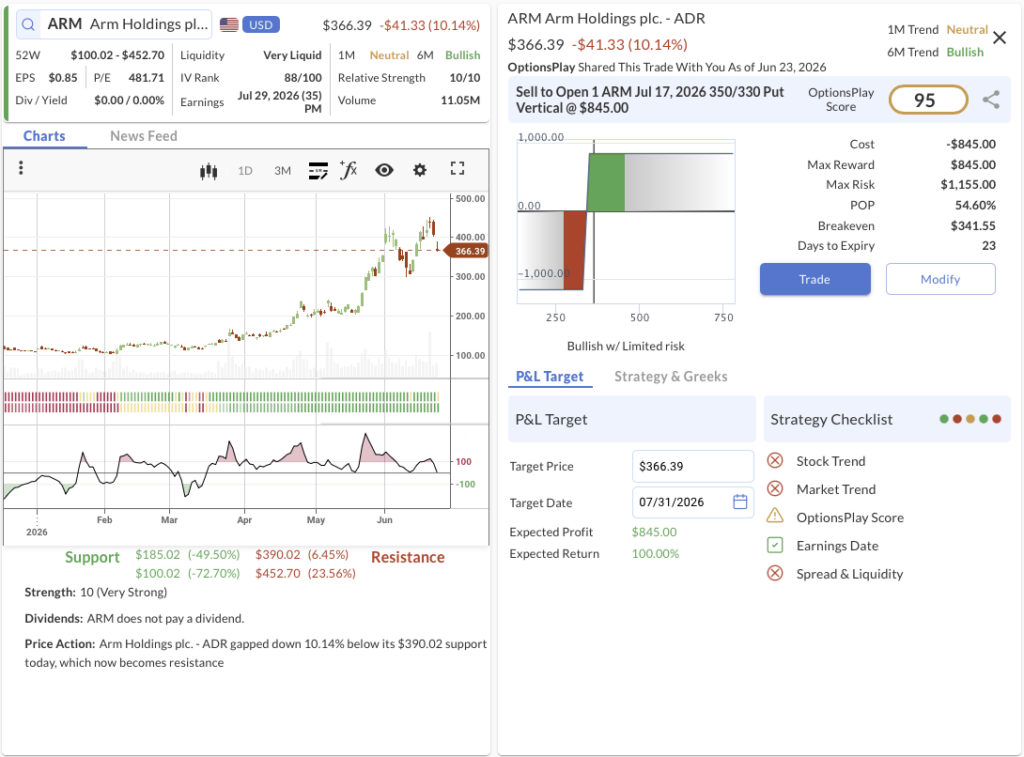
- We’re betting on: Arm’s royalty-rich model riding Armv9 and a data-center royalty stream that more than doubled year over year, using the semi-volatility pullback to sell rich premium, and for ARM to stay above $350 by expiration to capture the full credit.
- The Trade: Sell to Open the ARM Jul 17, 2026 350/330 Put Vertical @ $8.45 Credit.
- 🔴 SELL TO OPEN Jul 17, 2026 350 Put @ $29.03
- 🟢 BUY TO OPEN Jul 17, 2026 330 Put @ $20.58
- Trade Metrics: POP: 54.61% | Collect $845 per contract vs. a Max Risk of $1,155 (1.37:1).
- The Setup: After Tuesday’s semiconductor volatility, ARM’s implied volatility is extremely elevated and the pullback offers a far more compelling risk/reward for adding bullish chip exposure. ARM carries a perfect 10/10 relative-strength score with a bullish 6M trend, backed by 21% royalty growth and data-center royalties that more than doubled as Arm-based designs approach half of new hyperscaler CPU compute. Selling a put spread just below the 26-day EMA still collects more than 40% of the strike width: the 350/330 put vertical brings in $845 while defining risk below the $341.55 breakeven, with major support far below at $185. With 24 days to expiry and a 54.61% probability of profit, elevated premium and time decay both work in our favor as long as ARM holds above $350.
- Management:
- Stop Loss: Buy back the spread at $16.90 (100% loss of credit received).
- Take Profit: Buy back the spread at $4.23 (50% of max gain).
ANET, VRTX
OptionsPlay DailyPlay Ideas Menu – June 23rd, 2026
What’s Driving The Market
- Mega-Cap Tech Cracks on a Single-Name Selloff: Alphabet fell about 6.8% to near $343 in one of its worst sessions in a year, hit by a second high-profile AI defection in a week (Gemini co-lead Noam Shazeer to OpenAI), full-year AI capex approaching $190 billion, and an investment-portfolio markdown tied to the SpaceX collapse. SpaceX itself fell 15.45% to $156.41 on cash-burn and bond-offering anxiety, dragging the rest of the Magnificent 7 lower (Amazon -4.8%, Microsoft -3%, Meta -2.3%) and weighing on the Nasdaq.
- The Dow Holds and Small-Caps Make History: Beneath the tech selloff was a clear rotation, with the Dow closing +148 points (+0.29%) led by a nearly 4% Caterpillar gain as cyclicals and industrials caught the bid. More notably, the Russell 2000 climbed +0.83% to 3,004.40, its first close above 3,000 in the index’s history, the breadth signature bulls have been waiting for, though its durability depends on whether yields cooperate.
- Yields Don’t Cooperate Yet: The 10-year Treasury rose 6 bps to 4.52%, its highest in about two weeks, and the 2-year pushed above 4.20%, the highest since February 2025, as investors returned from the Juneteenth long weekend re-pricing for a sticky-inflation, hawkish-Fed regime. Futures now imply roughly a 50% probability of a 25 bp hike at the September FOMC, a complete reversal from the cut narrative that opened Q2.
- Energy Lower as Hormuz Reopens: WTI fell to around $74.30 and Brent to roughly $78.20, both near their lowest since early March, after US-Iran negotiators concluded the Switzerland round with a published road map toward a final deal within 60 days and a Hormuz communication line to avoid incidents. Iran’s visible Hormuz throughput is the highest since the conflict began and the national average pump price has eased to $3.929 per gallon, leaving rates and earnings, not oil, as the macro overhang.
💰 The Income Generators (High Probability, Cash Flow)
- ANET: Sell a put vertical on a 10/10 networking leader coiling for an all-time-high breakout above $180.
🚀 The Growth Seekers (Higher Risk, Max Reward)
- VRTX: Long call vertical riding the breakout above $450 toward the $500 target.
🛡️ The Portfolio Protectors (Hedges & Bearish Bets)
- (No trades in this category today)
1. ANET ($174.56): Coiling for an All-Time-High Breakout

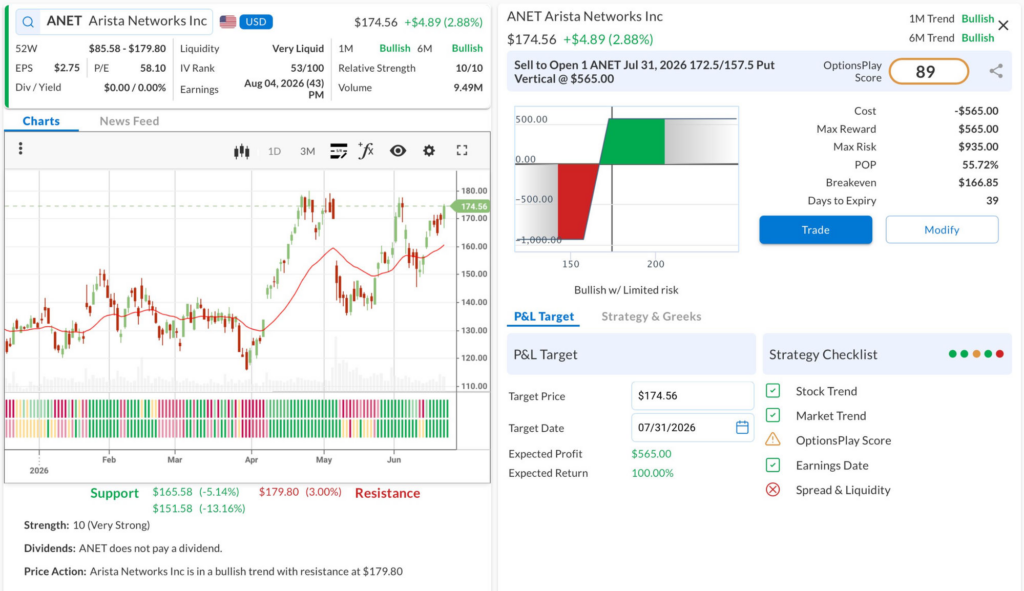
- We’re betting on: Arista’s 10/10 relative-strength leadership in AI and cloud networking, where Q1 revenue grew 35% to $2.71B and management raised its 2026 AI target to $3.5B, and for ANET to stay above $172.50 by expiration to capture the full credit.
- The Trade: Sell to Open the ANET Jul 31, 2026 172.5/157.5 Put Vertical @ $5.65 Credit.
- 🔴 SELL TO OPEN Jul 31, 2026 172.5 Put @ $11.45
- 🟢 BUY TO OPEN Jul 31, 2026 157.5 Put @ $5.80
- Trade Metrics: POP: 55.72% | Collect $565 per contract vs. a Max Risk of $935 (1.65:1).
- The Setup: ANET is on the verge of breaking out to all-time highs above its $180 resistance with strong relative strength, opening a path toward the $200 target. The stock scores a perfect 10/10 on relative strength with both its 1M and 6M trends bullish, riding 35% revenue growth and raised full-year guidance as demand for 800G AI back-end Ethernet outstrips supply across wafers, chips, and optics. Selling the 172.5/157.5 put vertical collects premium while defining risk below the $166.85 breakeven and the $165.58 support. With 39 days to expiry and a 55.72% probability of profit, time decay works in our favor as long as ANET holds above $172.50.
- Management:
- Stop Loss: Buy back the spread at $11.30 (100% loss of credit received).
- Take Profit: Buy back the spread at $2.83 (50% of max gain).
2. VRTX ($466.79): Breakout Above $450 Toward $500

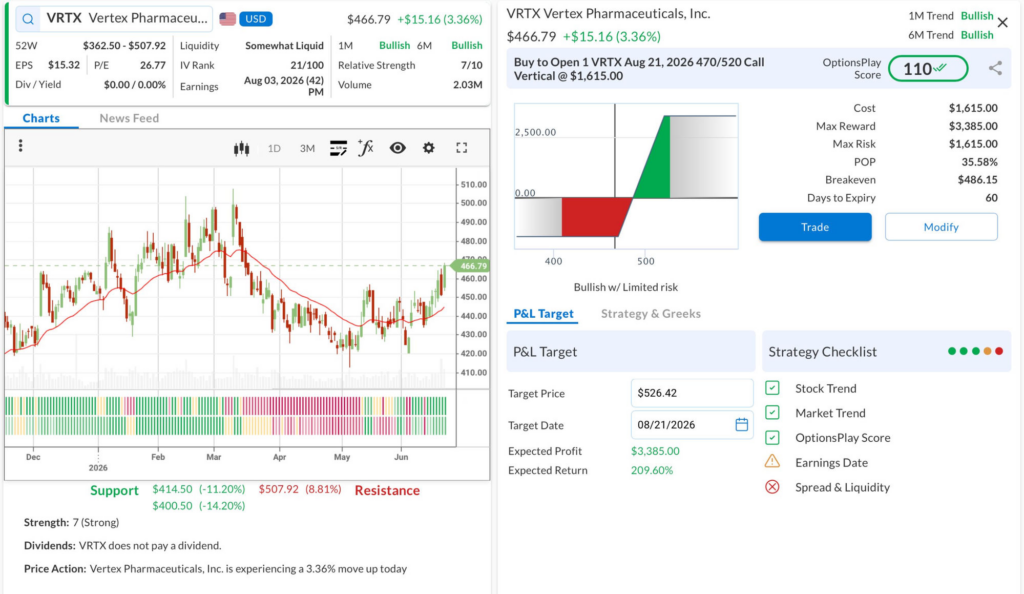
- We’re betting on: Vertex’s durable cystic-fibrosis monopoly plus fast-ramping new drivers in Journavx and Casgevy (over 25% of Q1 growth), with 2026 revenue guided to nearly $13B, and for VRTX to close above $520 by expiration to capture the full spread.
- The Trade: Buy to Open the VRTX Aug 21, 2026 470/520 Call Vertical @ $16.15 Debit.
- 🟢 BUY TO OPEN Aug 21, 2026 470 Call @ $23.50
- 🔴 SELL TO OPEN Aug 21, 2026 520 Call @ $7.35
- Trade Metrics: POP: 35.58% | Pay $1,615 per contract vs. a Max Reward of $3,385 (2.10:1).
- The Setup: VRTX recently broke out above its $450 level on strong relative strength, which looks constructive for a move toward the $500 target. The stock scores 7/10 on relative strength with both its 1M and 6M trends bullish, supported by a durable cystic-fibrosis monopoly and fast-ramping launches in Journavx, the first new non-opioid pain mechanism in decades, and the Casgevy gene therapy, which together drove over a quarter of Q1 growth. The 470/520 call vertical captures the continuation with defined risk, a breakeven at $486.15, and support at $414, with a close above $520 at expiration delivering the full reward.
- Management:
- ⚠️ Warning: Earnings are scheduled for August 3, 2026, potentially requiring active monitoring around the event.
- Stop Loss: Sell the spread at $8.08 (50% loss of premium).
- Take Profit: Sell the spread at $28.26 (75% gain on premium).
GEV, MLM
OptionsPlay DailyPlay Ideas Menu – June 22nd, 2026
What’s Driving The Market
- Two-Track Relief Rally: Markets staged a broad relief rally Thursday, with three of the four major indices closing solidly higher as two catalysts converged: an Iran framework signing scheduled for Friday in Switzerland and a more constructive reconsideration of Wednesday’s hawkish Fed shock.
- Iran Framework Signing Friday: Senior US officials disclosed the memorandum of understanding will be signed June 19, ending fighting on all fronts including Lebanon, reopening the Strait of Hormuz to commercial traffic, and lifting the US naval blockade on Iran. The IEA estimates the blockade had disrupted more than 14 million barrels per day of Middle East output since late February. WTI fell to about $75 and Brent to about $78, removing the war-risk premium that has weighed on margins for domestically focused businesses since the conflict began.
- Fed Shock Reconsidered: Markets digested Warsh’s first FOMC more constructively as the session progressed. Wednesday’s hold at 3.50 to 3.75% had triggered a selloff on the hawkish dot plot (9 of 18 officials projecting at least one 2026 hike, median end-2026 funds rate raised to 3.8% from 3.4% in March). Today’s read: with oil receding, the upside inflation impulse the Fed was responding to may be peaking.
- Leadership in Small-Caps and Semis: The Russell 2000 led all major indices at +2.02% to 2,977.16 as the highest-beta beneficiary of lower oil and lower inflation risk, and the Nasdaq added 1.91% with chips extending their rally (SOXX +70% YTD even after last week’s 10% pullback, AMD +130% YTD, Nvidia +20% on Blackwell demand and the Rubin roadmap). The Dow lagged, as mega-cap industrials carry less direct exposure to the Iran-premium unwind and more sensitivity to the Fed’s hawkish 2027 path.
- Cross-Asset Tells: Gold fell 0.97% to $4,218 as the risk-off premium drains with the conflict resolving, the 10-year sits near 4.45% with the bond market splitting the difference between Fed hawkishness and oil disinflation, and the VIX unwound Wednesday’s Fed-shock spike to 18.44, reflecting a conventional rather than crisis regime.
💰 The Income Generators (High Probability, Cash Flow)
- (No trades in this category today)
🚀 The Growth Seekers (Higher Risk, Max Reward)
- GEV: Long call vertical riding the early breakout in power and electrification toward the $1,200 target.
- MLM: Long call vertical on an early breakout in aggregates as capital rotates into small-cap industrials, targeting $700.
🛡️ The Portfolio Protectors (Hedges & Bearish Bets)
- (No trades in this category today)
1. GEV ($1,109.19): Powering the Breakout Toward $1,200

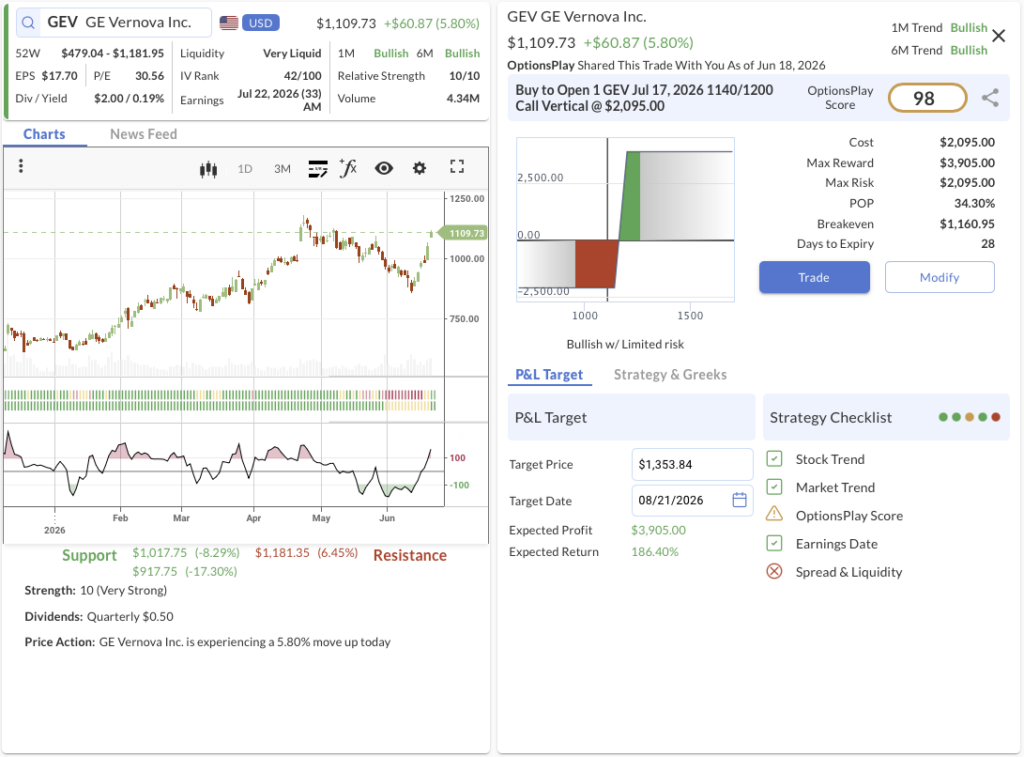
- We’re betting on: GE Vernova’s grid and gas-turbine dominance riding surging data-center power demand, with gas backlog topping 100 GW and raised 2026 guidance, and for GEV to close above $1,200 by expiration to capture the full spread.
- The Trade: Buy to Open the GEV Jul 17, 2026 1140/1200 Call Vertical @ $20.95 Debit.
- 🟢 BUY TO OPEN Jul 17, 2026 1140 Call @ $50.20
- 🔴 SELL TO OPEN Jul 17, 2026 1200 Call @ $29.25
- Trade Metrics: POP: 34.30% | Pay $2,095 per contract vs. a Max Reward of $3,905 (1.86:1).
- The Setup: GEV triggered our early-breakout detector on strong volume and is pushing toward the $1,200 target. The stock carries a perfect 10/10 relative-strength score with both its 1M and 6M trends bullish, riding a record power-equipment cycle where gas-turbine backlog and slot reservations are tracking toward at least 110 GW by year-end and Q1 electrification orders tied to data centers exceeded all of 2025. Today’s risk-on, lower-oil tape and the rotation into power and industrials reinforce the move. The 1140/1200 call vertical captures the continuation with defined risk, a breakeven at $1,160.95, and support at $1,018, with a close above $1,200 at expiration delivering the full reward.
- Management:
- Stop Loss: Sell the spread at $10.48 (50% loss of premium).
- Take Profit: Sell the spread at $36.66 (75% gain on premium).
2. MLM ($609.13): Aggregates Breakout, Rotation Into Industrials

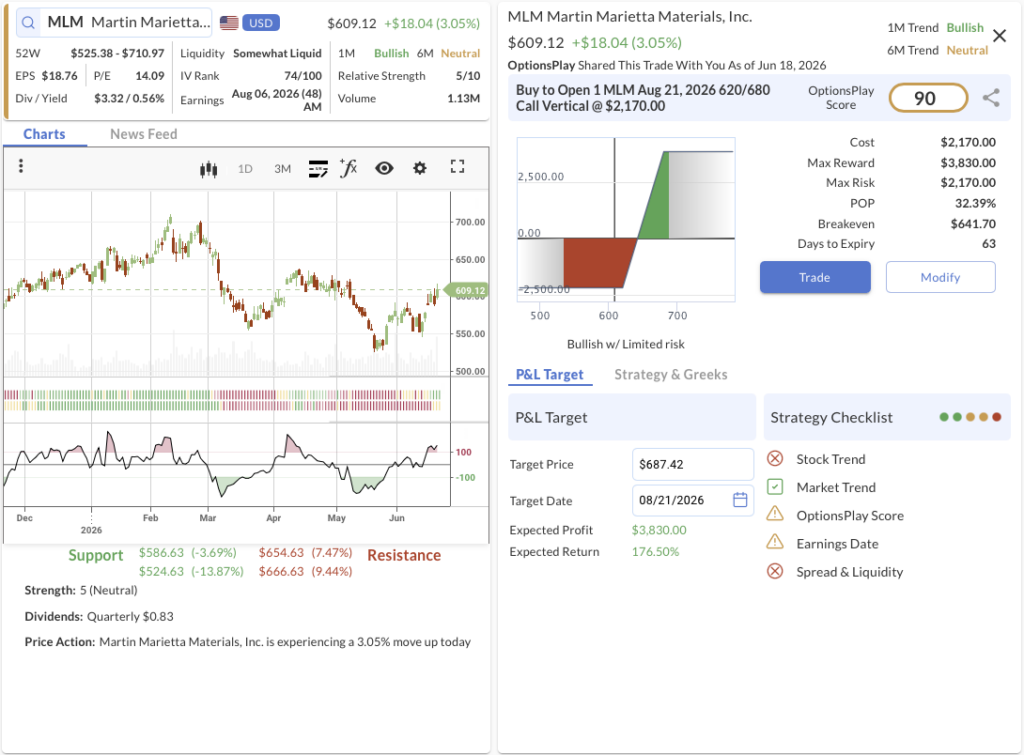
- We’re betting on: Martin Marietta’s aggregates pricing power and compelling valuation as capital rotates into small-cap industrials, with record Q1 revenue and reaffirmed 2026 guidance, and for MLM to close above $680 by expiration to capture the full spread.
- The Trade: Buy to Open the MLM Aug 21, 2026 620/680 Call Vertical @ $21.70 Debit.
- 🟢 BUY TO OPEN Aug 21, 2026 620 Call @ $27.60
- 🔴 SELL TO OPEN Aug 21, 2026 680 Call @ $5.90
- Trade Metrics: POP: 32.39% | Pay $2,170 per contract vs. a Max Reward of $3,830 (1.76:1).
- The Setup: MLM triggered our early-breakout detector with a compelling valuation near 14x earnings as the market rotates into smaller-cap industrial names, targeting $700. The 1M trend has turned bullish on a 3.05% move, though relative strength is still catching up at 4/10 with the 6M trend neutral, so this is a defined-risk rotation bet rather than an established leader. The aggregates engine is firing, with record Q1 revenue up 17%, organic pricing growth of 4% to 6%, and reaffirmed 2026 EBITDA guidance underpinned by federal and state infrastructure spending. The 620/680 call vertical captures the move with a breakeven at $641.70 and support at $587, and a close above $680 at expiration delivers the full reward.
- Management:
- ⚠️ Warning: Earnings are scheduled for August 6, 2026, potentially requiring active monitoring around the event.
- Stop Loss: Sell the spread at $10.85 (50% loss of premium).
- Take Profit: Sell the spread at $37.98 (75% gain on premium).
HOOD, PEP
OptionsPlay DailyPlay Ideas Menu – June 18th, 2026
What’s Driving The Market
- FOMC Inflection, Cuts Off the Table: Coming into June 17 the curve priced roughly one cut by year-end and the March dots implied 2026 easing; the new dots wipe that out and price asymmetric hawkish risk. The directional message is clear: cuts are off the table absent a meaningful growth slowdown, and a hike before year-end is now the base case for half the committee. Warsh’s verbal framing (“missed for five years”) signals he intends to anchor expectations around inflation credibility rather than the dual mandate.
- The 3.6% PCE Projection Is the Tell: The year-end PCE projection jumped to 3.6% from 2.7%, the most important number in the SEP, implying the committee now sees the Iran supply shock, tariffs in effect, and a still-tight labor market as compounding rather than fading. Inflation expectations are the channel they are defending, and the bond market’s bear-steepening reaction (10-year +3 bps, 2-year leading) is exactly what you would expect if traders read the dots as credibility-restoring rather than as a policy mistake.
- US-Iran Interim Deal: Iran gains an immediate sanctions waiver to resume oil exports plus a framework toward a $300 billion economic development program contingent on permanent peace, while the US gains a 60-day window for nuclear talks with strict limits, a Hormuz reopening plan, and an end to hostilities in Lebanon. Crude has fallen meaningfully since June 15 but settled higher today as the market digested execution risk, and the framework still has to be signed Friday and survive its first stress test.
- Labor Is the Wild Card: Initial jobless claims hit a three-month high of 229,000 in early June (vs 219,000 expected) with continuing claims at 1,795,000, both pointing to a labor market softening at the margin but nowhere near recessionary. Thursday’s claims print is the next read, and the bar matters: if claims keep drifting higher the hawkish dot plot becomes harder to defend, while a reversal reinforces the Fed’s credibility narrative.
💰 The Income Generators (High Probability, Cash Flow)
- (No trades in this category today)
🚀 The Growth Seekers (Higher Risk, Max Reward)
- HOOD: Long call vertical pressing a winning HOOD position as it breaks above $100 and confirms outperform.
🛡️ The Portfolio Protectors (Hedges & Bearish Bets)
- PEP: Long put vertical adding to two winning PEP shorts, targeting a move toward $127.
1. HOOD ($105.20): Pressing the Winner Through $100

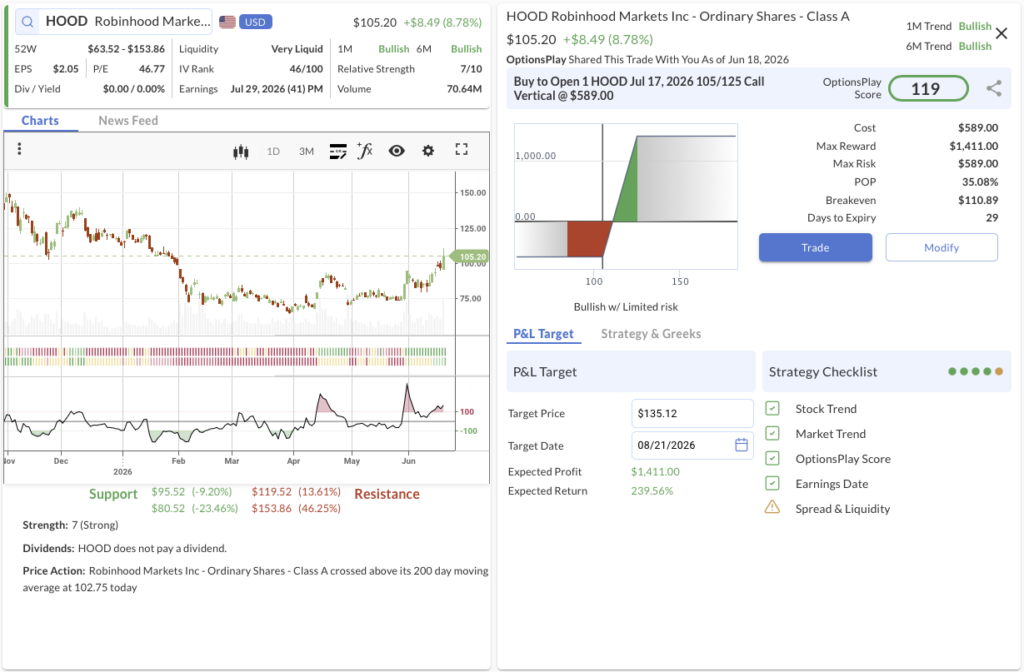
- We’re betting on: Robinhood’s confirmed-outperform breakout above $100 on its tokenization and crypto-driven growth, as we add to our June 16 position already up about 30%, and for HOOD to close above $125 by expiration to capture the full spread.
- The Trade: Buy to Open the HOOD Jul 17, 2026 105/125 Call Vertical @ $5.89 Debit.
- 🟢 BUY TO OPEN Jul 17, 2026 105 Call @ $8.50
- 🔴 SELL TO OPEN Jul 17, 2026 125 Call @ $2.61
- Trade Metrics: POP: 35.08% | Pay $589 per contract vs. a Max Reward of $1,411 (2.40:1).
- The Setup: This is the press-the-winner discipline in action: our June 16 HOOD position, the 98/86 put credit spread, is already up roughly 30%, and HOOD’s breakout above its $100 resistance with an upgrade to confirmed outperform is the signal to add directional exposure. The stock crossed back above its 200-day average at $102.75 today on an 8.78% surge, scores 7/10 on relative strength, and carries bullish 1M and 6M trends. The 105/125 call vertical adds defined-risk upside with a breakeven at $110.89 and support at $95, and a close above $125 at expiration delivers the full reward.
- Management:
- Stop Loss: Sell the spread at $2.95 (50% loss of premium).
- Take Profit: Sell the spread at $10.31 (75% gain on premium).
2. PEP ($141.59): Pressing the Short Toward $127

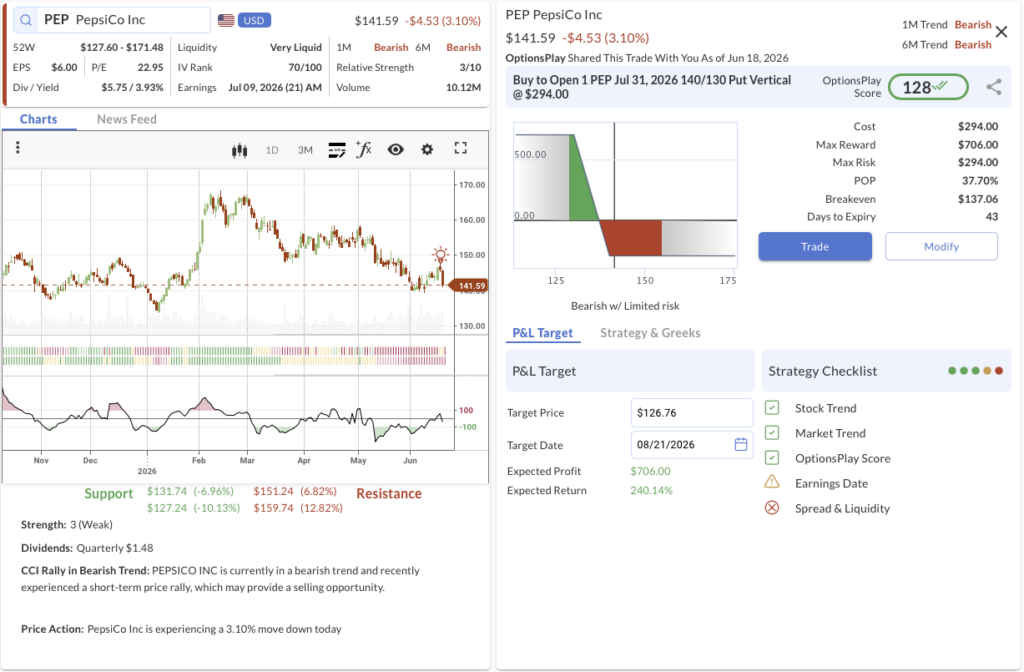
- We’re betting on: PepsiCo’s deteriorating volume trends keeping it in a confirmed downtrend, as we add to two profitable PEP shorts up 44% and 95%, and for PEP to fall below $130 by expiration to capture the full spread.
- The Trade: Buy to Open the PEP Jul 31, 2026 140/130 Put Vertical @ $2.94 Debit.
- 🟢 BUY TO OPEN Jul 31, 2026 140 Put @ $4.30
- 🔴 SELL TO OPEN Jul 31, 2026 130 Put @ $1.36
- Trade Metrics: POP: 37.69% | Pay $294 per contract vs. a Max Reward of $706 (2.40:1).
- The Setup: This is the press-the-winner discipline on the short side: our two existing PEP put spreads are both working, the May 11 155/145 up 95.4% and the May 15 150/140 up 44.0%, and today’s 3.10% drop as a short-term CCI rally fades inside a confirmed bearish trend is the add signal. PEP scores just 3/10 on relative strength with both its 1M and 6M trends bearish, mired below a falling 50-day average. The 140/130 put vertical targets the $127 area with defined risk, a breakeven at $137.06, and resistance overhead at $151, and a close below $130 at expiration delivers the full reward.
- Management:
- ⚠️ Warning: Earnings are scheduled for July 9, 2026, potentially requiring active monitoring around the event.
- Stop Loss: Sell the spread at $1.47 (50% loss of premium).
- Take Profit: Sell the spread at $5.15 (75% gain on premium).